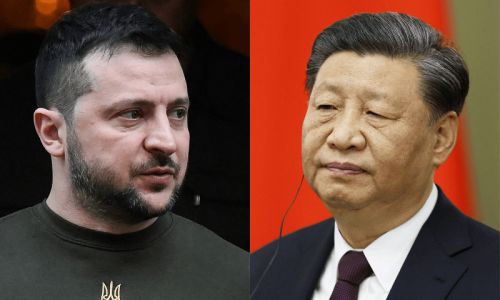
UNITED NATIONS: China and Brazil on Friday pressed ahead with an effort to gather developing countries behind a plan to end Russia’s war in Ukraine, despite Ukrainian President Volodymyr Zelensky’s dismissal of the initiative as serving Moscow’s interests.
Zelensky criticised China and Brazil in his UN address, saying that forcing Ukraine to accept a peace deal was akin to colonialism.
Seventeen countries attended a meeting on the sidelines of the United Nations General Assembly, chaired by China’s Foreign Minister Wang Yi and Brazilian foreign policy adviser Celso Amorim.
Wang told reporters they discussed the need to prevent escalation in the war, to avoid the use of weapons of mass destruction and prevent attacks on nuclear power plants.
“Russia and Ukraine are neighbours that cannot be moved away from each other and amity is the only realistic option,” Wang said, adding that the international community should support an international peace conference involving both Russia and Ukraine.
As well as Brazil and China, 10 countries from the Global South who were present, including Indonesia, South Africa and Turkiye, signed a communique that Amorim said builds on an earlier six-point plan proposed by Brazil and China in May.
Countries would continue to meet in New York under a grouping of “friends for peace”, he added.
In a thinly veiled criticism of Russian President Vladimir Putin, the two countries led a joint call against any use or threat of nuclear weapons over Ukraine.
“We call on refraining from the use or the threat of weapons of mass destruction, particularly nuclear weapons and chemical and biological weapons,” said the joint statement.
Putin this week threatened to use nuclear weapons in the event of a major attack on Russian soil as Ukraine, which his forces invaded in 2022, seeks Western weapons to strike deeper across the border.
Two days after Ukrainian President Volodymyr Zelensky in a UN address accused Russia of planning to attack his country’s nuclear reactors, China, Brazil and the other emerging powers said: “Civilian infrastructures, including peaceful nuclear facilities and other energy facilities, should not be the targets of military operation.”
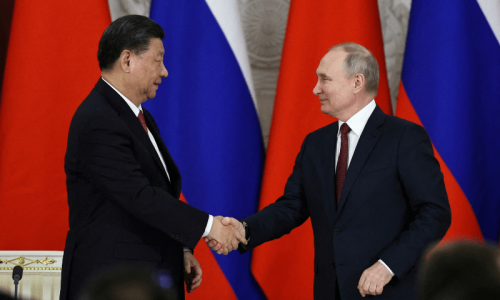
Chinese President Xi Jinping signed a “no limits” partnership deal with Russian President Vladimir Putin in 2022, less than three weeks before Russian troops entered Ukraine.
Beijing says it has not supplied Russia with weapons for use in Ukraine, but Western countries say its companies provide materials that Russia uses in the manufacture of weapons for the war.
Published in Dawn, September 28th, 2024