NEW YORK: The Quadrilateral Group comprising Pakistan, China, Iran and Russia has called on Afghanistan’s Taliban government to take “visible and verifiable actions” to dismantle terrorist groups operating from Afghan soil.
A joint statement issued by the group after a ministerial-level meeting held on the sidelines of the United Nations General Assembly (UNGA) identified several terrorist organisations operating in Afghanistan, including Daesh, Al-Qaida, the Eastern Turkestan Islamic Movement (ETIM), Jaish ul-Adl, the Balochistan Liberation Army (BLA), and the TTP. It mentioned that these outfits “pose a serious threat to regional and global security”.
The Taliban leadership was urged to “dismantle and eliminate all terrorist groups equally and non-discriminatory” and to prevent Afghan territory from being used to launch attacks against neighbouring countries and beyond.
The Quadrilateral Group expressed grave concerns about the security challenges posed by these outfits, warning that their activities threaten not only Afghanistan’s neighbours but also the region and beyond.
Pakistan, China, Iran and Russia express concern over ‘terror threat emanating from Afghan territory’
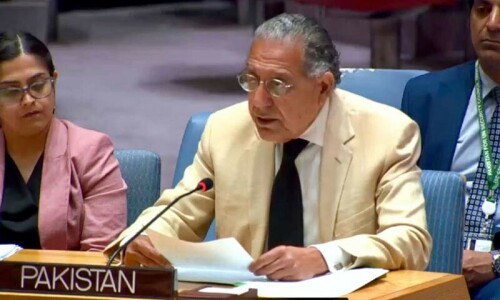
Defence Minister Khawaja Asif, in his remarks, highlighted the urgent need for Afghanistan’s interim government to prevent its territory from being used for cross-border attacks. “We have consistently urged the Afghan interim government to ensure that their land is not used for attacks against Pakistan. This is not only a matter of bilateral concern but a regional one,” he said.
However, he also emphasised the importance of sustained international engagement to comprehensively address the security threats. The joint statement echoed his concerns, noting that the participants were particularly alarmed by “the terrorism threat” emanating from Afghan territory.
The ministers also highlighted the need for continued coordination between the four nations to stabilise the situation in Afghanistan and address its wide-ranging challenges.
Rising terrorism, its impact on region
This was the third ministerial-level meeting of the Quadrilateral Group, formed to address the post-Taliban power shift in Afghanistan. Since the Taliban regained control in August 2021, militant activity has surged, particularly in Pakistan’s Khyber Pakhtunkhwa (KP) and Balochistan provinces, bordering Afghanistan. In August alone, 59 attacks were recorded in these regions, according to the Pakistan Institute for Peace Studies, a significant increase from 38 attacks in July.
The defence minister of Pakistan along with the foreign ministers of China, Iran and Russia at the meeting also expressed his concern over the rising number of attacks by the TTP and other outlawed groups. Islamabad has repeatedly urged Kabul to take action against these groups, which Pakistan claims are using Afghan territory as a base for attacks on its soil.
They also condemned recent terrorist attacks in the region, including the Daesh-led assault on Karbala pilgrims on Sept 13 and TTP’s attacks in Bannu and Besham areas of Pakistan.
The joint statement called for a ‘united effort’ to combat terrorism. “These terrorist attacks in all shapes and forms are unacceptable and highlight the pressing need for a coordinated approach to eradicate terrorism from the region.”
Support to Afghanistan
Beyond terrorism, however, the Quadrilateral Group reaffirmed its commitment to supporting Afghanistan’s sovereignty, unity, and territorial integrity. “All members of the international community have a shared interest in a stable and peaceful Afghanistan,” the ministers stressed.
The group reaffirmed its commitment to Afghanistan’s long-term peace, declaring that Afghanistan should be “supported in taking comprehensive measures to address both the symptoms and root causes of terrorism,” so that the country does not become a safe haven for terrorism and extremism. It also resolved to ensure Afghanistan is not turned into a ground for geopolitical competition rather collaborative efforts to stabilize the country.
One of the most pressing humanitarian issues discussed was the return of Afghan refugees. Since the Taliban takeover, neighbouring countries, particularly Pakistan and Iran, have seen a significant influx of Afghan refugees. Over 500,000 undocumented Afghans have already been repatriated from Pakistan as part of a campaign that began last year, according to UN figures.
The joint statement urged Afghanistan’s interim government to create conditions “conducive to the safe return of Afghan refugees” and to integrate the returnees into political and social processes for a lasting solution.
Financial support
The Quadrilateral Group also called on the international community to provide predictable and sustained financial support to both Afghanistan and the countries hosting Afghan refugees. “The international community must shoulder its responsibility and provide adequate, regular, and sustainable financial support,” the statement urged, emphasizing the need for time-bound, well-resourced repatriation programs to facilitate the safe and dignified return of refugees.
The ministers recognised the significant threat posed by drug trafficking and organised crime, emanating from Afghanistan. “Strengthening peace and stability in Afghanistan and countering the threats of terrorism and drug crime from its territory are in line with our common interests in the region,” they concluded.
Published in Dawn, September 30th, 2024