Eight Israeli soldiers killed as Hezbollah ‘repels’ infiltration


• Fighting turns south Beirut into ghost town
• Tehran, Tel Aviv issue dire warnings to each other
• Pakistan calls for de-escalation
BEIRUT: Hezbollah said it repelled an Israeli infiltration into southern Lebanon on Wednesday, as Israel reported eight soldiers were killed — its first losses since launching cross-border raids this week.
The clashes came hours after Iran launched its largest missile attack yet on Israel, warning that it would step up its response if Israel retaliates.
US President Joe Biden said on Wednesday he would not support a strike by Israel aimed at wiping out Iran’s nuclear facilities in retaliation for its latest missile attack.
“We’ll be discussing with the Israelis what they’re going to do,” he said, adding that all G7 members agree Israel has “a right to respond, but they should respond in proportion.
Meanwhile, Iranian President Masoud Pezeshkian again warned of a “stronger” response, though he stressed Iran was “not looking for war”.
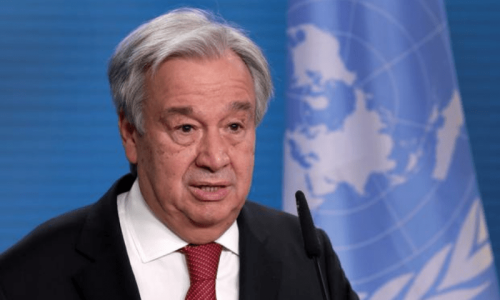
At the UN, meanwhile, both Israel and Iran on Wednesday threatened each other with retaliation if attacked, as the United Nations Security Council met amid fears of a wider war in the Middle East.
Expressing deep concern over the escalating hostilities in the Middle East, Pakistan on Wednesday also called for a de-escalation of hostilities and conflict resolution in the region.
A statement from the Foreign Office said Israel has “endangered regional peace and security with the ongoing genocide in Gaza. The recent invasion of Lebanon has further intensified these tensions, affecting the lives of innocent civilians.”
“Pakistan reiterates its call for the UN Security Council to uphold peace and security in the region, safeguard Lebanon’s sovereignty, and put an end to the ongoing humanitarian crisis in Gaza,” the statement said.
Targeting south Beirut
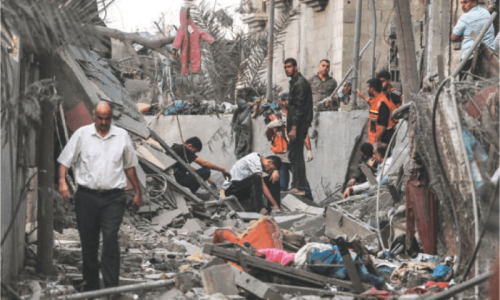
Israel continued to bombard south Beirut, an area of tightly packed blocks of flats, shops and businesses that is usually teeming with life.
But on Wednesday, the rubble-strewn streets and burning buildings were almost empty after days of Israeli bombardment and evacuation orders. AFP correspondents heard about 20 explosions and saw smoke billowing over the area.
Young men on mopeds sped along largely empty roads and residents grabbed what they could from their homes, some driving off with mattresses tied to car roofs.
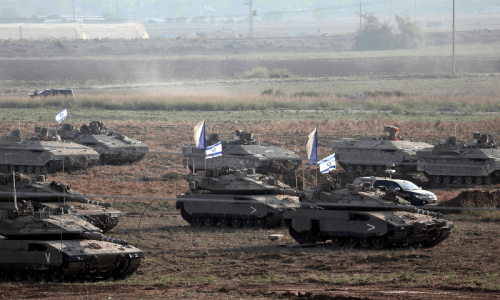
Hezbollah claimed it had forced Israeli soldiers to retreat, targeted an Israeli unit with explosives and destroyed three Merkava tanks with rockets as they advanced on Maroun al-Ras village.
The Israeli army said it staged two brief incursions into Lebanon, warning residents to evacuate more than 20 areas.
Lebanon’s disaster management agency said 1,873 people had died since Israel and Hezbollah began trading fire following the events of October 7 last year, displacing hundreds of thousands.
One casualty
Hours after Israel announced the start of ground operations in Lebanon on Tuesday, Iran had fired some 200 missiles including hypersonic weapons, sending frightened Israeli civilians into shelters.
The attack was retaliation for the deaths of Hassan Nasrallah and Gen Abbas Nilforoushan, the IRGC had said in a statement.
The Israeli military said several Iranian missiles struck inside air force bases without causing any casualties or damage.
Two people were wounded by shrapnel and one Palestinian man was said to be the only casualty.
The man was killed when “pieces of a rocket fell from the sky and hit him”, Jericho governor Hussein Hamayel said.
Separately, the Reuters news agency claimed on Wednesday that Iran’s Supreme Leader Ayatollah Ali Khamenei warned Hezbollah leader Sayyed Hassan Nasrallah to flee Lebanon days before he was assassinated.
The message was passed on by Gen Nilforoushan, who died in the same strike that killed Nasrallah.
Following the assassination, Khamenei is said to be worried about Israeli infiltration of Tehran, has remained in a secure location inside Iran since Saturday.
Officials said he personally ordered a barrage of around 200 missiles to be fired at Israel on Tuesday.
Global alarm
Iran’s missile attack, its second against Israel in six months, triggered widespread global alarm, as well as a spike in world oil prices.
The G7 group of rich nations vowed to work together to reduce tensions in the region and said a diplomatic solution was “still possible”.
China urged world powers to prevent the situation in the Middle East from “further deteriorating” following the latest escalation in the region.
“The Chinese side calls on the international community, especially major influential powers, to truly play a constructive role and prevent the situation from further deteriorating,” a foreign ministry spokesman said in a statement.
Saudi Arabia too seemed to be hoping for de-escalation and dialogue, Economy Minister Faisal al-Ibrahim said when asked at a conference in Berlin about the situation in the Middle East following Iran’s missile attack against Israel.
Al-Ibrahim called the escalation unfortunate but said it was very hard to avoid discussing.
“We hope that wisdom will prevail, de-escalation will happen, dialogue will come into place and more collaboration will be seen globally, but also regionally for us to address these challenges,” he said.
Flight chaos
Rising tensions in the Middle East have created air travel chaos, with global airlines diverting or cancelling flights on Wednesday and regional airports, including Lebanon, Israel and Kuwait, showing long delays.
On Wednesday afternoon, flights were seen over Iranian airspace including from carrier flydubai and Wizz Air. However, flights across the entire region were diverted or disrupted with little sign of broader normalisation, with some changing their routes to avoid certain airspace.
Traffic over the Istanbul, Cairo and Antalya hubs remained dense as flights continued to avoid parts of Middle Eastern airspace.
All of the flights departing Abu Dhabi Zayed International Airport were delayed.
“All planes — mainly flights to India are avoiding Iranian airspace until further notice,” said a spokesperson for the Polish flag carrier.
Europe’s aviation safety regulator EASA issued a conflict zone information bulletin on Wednesday advising airlines to avoid Iranian airspace “at all flight levels” as worries over retaliatory attacks from Israel targeting Iran rose.
Published in Dawn, October 3rd, 2024