Pakistan’s Foreign Office adjusted its position — within a week — on US President Donald Trump’s announcement about retrieving leftover American military equipment from Afghanistan.
The Foreign Offices said: “These weapons have been used by terrorist organisations, including Tehreek-i-Taliban Pakistan, to carry out terrorist attacks in Pakistan.” The FO spokesman had previously said: “This is essentially an issue between two governments, which is the United States and Afghan interim authorities,” according to a Dawn report.
This is an example of how Pakistan may have to assess its stance on geopolitical or geostrategic matters involving the US. Continued Chinese support is a must to keep economic progress steady. But so far, efforts in implementing China-Pakistan Economic Corridor projects have not impressed Beijing. On the contrary, China is becoming frustrated with Pakistan’s “rhetorics” and “inefficiencies”, according to The Guardian. With concerns about the security of its nationals in Pakistan, it has increased diplomatic pressure for action against the militants.
Ignoring growing opposition, President Asif Ali Zardari gave his ascent to amendments to the Prevention of Electronic Crimes Act 2016 with all its free speech-throttling provisions.
The splurging of public money continues, which may ultimately necessitate the government borrowings increasing again
Keeping the above context in mind, it may help understand what will happen in the near future of Pakistan’s politics and economy, with the main opposition party, PTI and Imran Khan, continuing to publicly challenge the government and other players. If the party agrees to play a part in line with the ‘Pakistan-first’ vision, it may get something in return. If not, the hybrid regime probably won’t offer them any concessions.
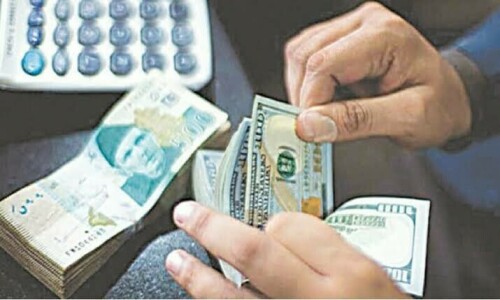
Coming to the economy, the “hot money” Pakistan had attracted — during the days of its tight monetary regime — has started evaporating. According to the State Bank of Pakistan (SBP), foreign portfolio investment in our treasury bills totalled $984 million between July 1, 2024, and January 17, 2025. But outflows siphoned off $852m. We may see more outflows following one more cut in the SBP interest rate — from 13 per cent to 12pc announced on January 27.
The business community is unhappy with this cautious monetary easing and wants deeper cuts in the interest rate. The SBP may choose to ignore their demand, but even well-calculated cuts in interest rates are bound to lower net volumes of foreign portfolio investment, particularly in government debt papers. That is a big concern when foreign direct investment isn’t growing much in volume.
During the first half of this fiscal year, between July and December 2024, Pakistan received a total of $1.33 billion in foreign direct investment, 40pc of which originated from China alone. For context, the amount is about half of the monthly goods’ exports and less than half of the monthly inflows of remittances.
It seems all the hype created about the “billions of dollars coming in soon” in agriculture, mining, energy, information technology and infrastructure projects was just that — hype. The memoranda of understanding (MoUs) signed for scores of these projects were mere paper waste. Unless sizable funds start flowing into these projects, this impression may last in the minds of ordinary Pakistanis, unaware of the geopolitical and geostrategic complexities involved in translating MoUs into steady inflows of foreign exchange.
The SBP’s latest rate cut was the sixth one in a row since June 2024, dragging the rate down from its height of 22pc before then. It has partly helped ease domestic inflation, while the other part was played by a decline in domestic demand and industrial output last year. But if you expect fiscal authorities, too, to act strictly in line with the SBP’s efforts to discourage monetary expansion, you’re being optimistic.
The splurging of public money continues, which may ultimately necessitate government borrowings from banks, crowding out the private sector, hampering the production of short-term output of goods and services, and the long-term development of production capacities.
According to the SBP, the federal government’s borrowing from banks between July 1, 2024, and January 17, 2025, remained negative; one must appreciate that. However, during the second half of the year, it is bound to grow as political considerations have started dictating the government’s spending, for example, the nearly 200pc increase in the parliamentarians’ pay.
Published in Dawn, The Business and Finance Weekly, February 3rd, 2025