THE latest report of the UN Security Council’s sanctions monitoring team paints a grim picture of the banned TTP’s growing operational capacity.
It says that “the status and strength of TTP in Afghanistan had not changed”, but its attacks on Pakistan have “significantly increased, with over 600 attacks during the reporting period [July-December], including from Afghan territory”. This underscores Pakistan’s long-standing concern at Afghan soil being used for cross-border violence.
Despite the Afghan Taliban’s reassurance that their territory would not be used for terrorism against any country, the report confirms that they “continued to provide TTP with logistical and operational space and financial support”, including funds for the TTP leadership and the creation of new training centres in Kunar, Nangarhar, Khost, and Paktika provinces. Such support undermines Pakistan’s security and further strains its ties with Kabul.
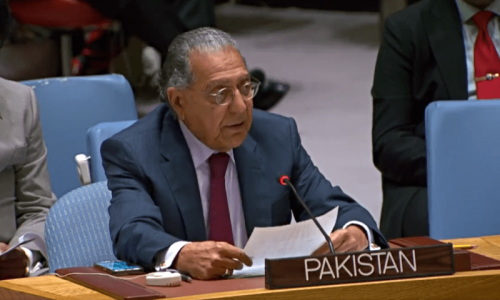
Pakistan’s ambassador to the UN Munir Akram had also warned the UNSC that the TTP was now “an umbrella organisation” for various militant actors, increasing the risk of regional instability. The report corroborates this, noting that the TTP’s coordination with Al Qaeda and other extremist outfits “might transform [TTP] into an extra-regional threat”.
Islamabad has historically pursued a dual-track approach to dealing with the TTP menace — diplomatic engagement with Kabul alongside military action against the terrorists.
However, with the Taliban’s continued reluctance to take concrete action against the TTP, Pakistan has also resorted to cross-border strikes against militant hideouts in Afghanistan. While such operations may provide short-term relief, unilateral military actions are not a sustainable solution. They risk worsening relations with Afghanistan and complicating broader stability.
Pakistan must intensify its diplomatic engagement with Kabul, stressing that its tolerance of the TTP is a serious breach of regional peace and bilateral trust. The Afghan Taliban leadership, in turn, must recognise that harbouring groups like the TTP will only increase global scrutiny and isolate them further.
Unfortunately, instead of accepting the realities detailed in the report, the Afghan Taliban have rejected the findings, dismissing them as propaganda. This can only be perceived as a sheer unwillingness to act, an approach that has implications not only for the Pak-Afghan relationship but also regional security. The international community must continue to ramp up the pressure.
Published in Dawn, February 17th, 2025