Inflation has apparently bottomed out, but Pakistan’s journey to economic recovery may become even harder.
The country’s national average inflation hit a decade-low in February 2025, with annual CPI inflation dropping to 1.5 per cent, down from 23.1pc a year earlier, according to the Pakistan Bureau of Statistics (PBS).
This sharp decline signals the impact of economic stabilisation efforts, including a $7 billion International Monetary Fund (IMF)-backed reform package and aggressive monetary easing. Since June 2024, the State Bank of Pakistan (SBP) has cut the policy rate by 10 percentage points, bringing it to 12pc in January 2024.
When we talk about the IMF-prescribed stabilisation efforts, we must keep in mind they have contained aggregate domestic demand growth: people’s real income adjusted for inflation either remained static or fell, and industrial production and commercial activities became so costly due to energy price hikes and new or increased taxes that industrial output squeezed, and commercial activities shrank.
With inflation set to potentially rise, the state battles with a widening trade deficit, a rural-urban divide, and a stagnant large-scale manufacturing sector
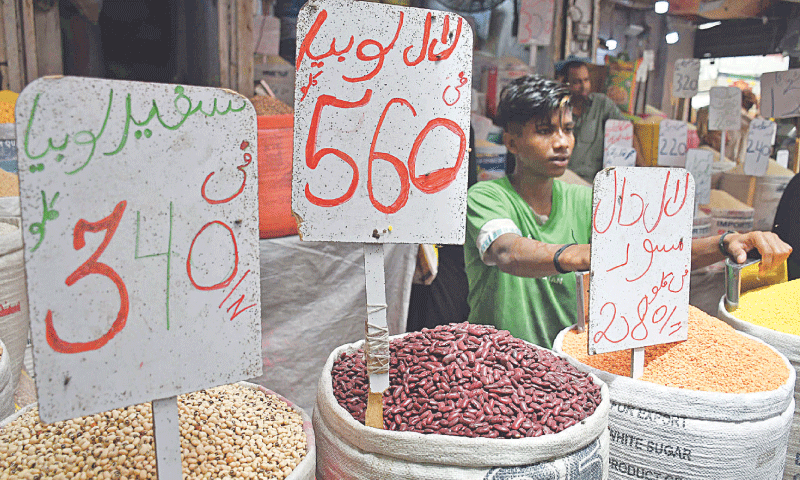
Despite a recent respite, inflation is expected to rise slightly in the coming months due to Ramazan-driven food demand and a fading base effect. The future pace of increase in price lines will also depend on the pace of economic recovery.
The finance ministry had projected February inflation between 2-3pc, with a further uptick to 3-4pc in March, after which consumers and businesses must be ready to brave rising inflation because the rupee that has so far remained stable may start taking a hit from the widening trade deficit.
While inflation eases, Pakistan’s trade deficit is widening. In January 2025, it expanded 18pc year-on-year to $2.3bn. In February, the deficit surged over 33pc year-on-year to $2.3bn.
Falling exports — down 5.6pc year-on-year in February — and rising imports, fuelled by economic recovery and higher industrial demand, drove this trend.
The IMF and the Asian Development Bank project Pakistan’s FY25 GDP growth at 3pc, whereas the World Bank’s projection is a bit lower at 2.8pc. Even a 2.8pc growth could push imports higher (more so amidst consistent IMF pressure for further liberalisation of the import regime), widening the current account deficit (CAD). A swelling CAD exerts pressure on the exchange rate, increasing import costs and external debt servicing. A weaker rupee, in turn, can reignite inflationary pressures, reversing recent gains.
To counter these risks, Pakistan must focus on boosting exports, curbing unnecessary imports without attracting IMF objections, promoting import substitution, and attracting foreign investment. Strengthening domestic industries, diversifying trade partners, and maintaining fiscal discipline are crucial to stabilising the external account.
A strong indication of whether our policymakers realise the gravity of the challenges ahead would come later this month when the SBP is due to revise its monetary policy.
Meanwhile, the structural issue of income disparity remains unaddressed. According to the United Nations Development Programme’s (UNDP) 2020 National Human Development Report on Pakistan, the richest 10pc in the country hold 40pc of total wealth, while the bottom 40pc own just 17pc.
These values may have deteriorated further for the poorer sections of the population now, but more recent data isn’t available. The economic strain of 2024 pushed 13m more people below the poverty line, raising the poverty rate to 25.3pc.
More recently, the UNDP’s 2023-24 report highlights a 33pc decline in Pakistan’s inequality-adjusted Human Development Index, signalling deteriorating access to education, healthcare, and jobs.
Rural-urban disparity remains stark. Farmers struggle with outdated technology, poor infrastructure, and limited market access. Gender inequality further deepens income gaps, with Pakistan ranking 135th out of 166 countries on the Gender Inequality Index.
Addressing these challenges requires policies that foster inclusive growth — expanding education and
healthcare access, supporting small businesses, and ensuring equal opportunities across gender and geography. Without structural reforms, easing inflation alone won’t reduce the economic divide, which is becoming increasingly important for sustainable economic growth.
Pakistan stands at a difficult turn. Lower inflation offers short-term relief, but rising trade imbalances and persistent income disparity demand urgent policy action. Stabilisation is not enough; long-term, equitable growth must be the goal. But marrying objectives with means is necessary. Setting lofty national objectives is one thing, and achieving them under fiscal and geopolitical constraints is another.
During the first two quarters of this fiscal year, the current hybrid regime has financed fiscal deficits (Rs1.896 trillion and Rs1.538tr respectively) entirely from bank borrowings (Rs1.874tr and R2.025tr respectively), data released by the Ministry of Finance reveals. Small wonder then that banks continue lending to the government aggressively, forgetting the actual needs of the private sector. The private sector, suffering from a lack of formal financing, fails to contribute as much to the country’s economy as it should.
We must not forget that large-scale manufacturing (LSM) output has still not started growing. Between the first half of this fiscal year (between July and December 2024), the LSM output contracted 1.87pc year-on-year. The rate of contraction was even greater — 3.73pc in the month of December alone, PBS data reveal.
Published in Dawn, The Business and Finance Weekly, March 10th, 2025