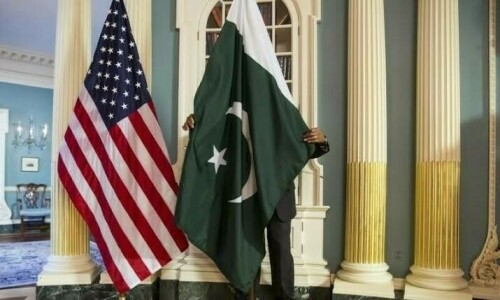
THE Trump administration has attacked the liberal world order, built on multilateral alliances like Nato, the EU and Bretton Woods institutions.
For Pakistan, the changes have spawned challenges, which include diminished climate finance, decreased development aid, restructured ties with IFIs and altered trade paradigms. How can we respond?
President Donald Trump’s foreign policy treats alliances and values as transactional tools. This has emerged as a serious challenge for Pakistan, particularly in planning long-term resilience and development strategies. The unpredictability threatens our economic stability and capacity to cope with climate risks and shocks.
The US withdrawal from the Paris Agreement has added to existing funding gaps in global climate finance. The Green Climate Fund will now face an additional $2 billion shortfall, while the Fund for Responding to Loss and Damage, too, has been undermined, threatening support mechanisms for climate-vulnerable countries. Pakistan’s vulnerability has reached critical levels: the annual cost of essential adaptation measures exceeds $9bn, while mitigation efforts to transition from fossil fuels to renewable energy (RE) require an additional $5bn to $8bn annually.
Foreign assistance reduction impacts: US foreign aid policies have shifted, prioritising strategic interests over humanitarian and development aims. The termination of USAID funding has halted 39 critical programmes in Pakistan, resulting in an estimated cut of $845 million in commitments across health, education, governance, energy, economic development, agriculture and climate change, thus adversely impacting the climate adaptation landscape.
Pakistan faces reductions in aid across education, healthcare & infrastructure.
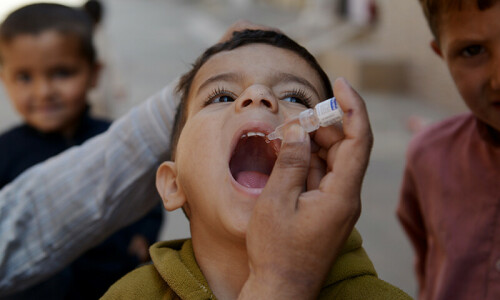
The cessation of USAID-supported immunisation programmes threatens a health emergency. USAID previously co-funded campaigns against polio, tuberculosis, hepatitis and measles.
The halt in support threatens public health programmes and can cause a resurgence in polio numbers. It has already led to thousands of healthcare workers, educators, and development professionals losing jobs, and undermining organisational capacity across provinces. Climate-related public health initiatives addressing heat-related, waterborne, and respiratory illnesses caused by extreme weather have also been hard hit.
Transformation of international financial architecture: An elaborate policy blueprint, Mandate for Leadership: The Conservative Promise, known as Project 2025, is a 920-page playbook prepared for Trump’s second term. The administration’s scepticism regarding IFIs threatens the operational stability of the World Bank and others. Project 2025 calls for a US withdrawal from the World Bank, meanwhile pushing for reduced US financial contributions but retaining veto power. The critique of the WB’s climate finance focus conflicts with its commitment to allocate 45 per cent of projected commitments to Paris Agreement-compliant lending.
The WB’s apparent reluctance to fund Pakistan’s RE transition (because of the country’s inability to deliver on sectoral reforms) reflects a global shift towards fossil fuel-friendly projects aligning with Trump’s energy agenda. The withdrawal of the $500m Pakistan Programme for Affordable and Clean Energy exemplifies this shift. Concurrently, the WB’s private sector arm, the International Finance Corporation (IFC), has directed $3.7bn annually into fossil fuels through opaque ‘trade finance’ mechanisms, ostensibly diluting its Paris Agreement commitments.
For Pakistan, these changes threaten ongoing energy, agriculture, and flood resilience projects under the WB’s 10-Year Country Partnership Framework (2025-2035), committing $20bn to addressing critical challenges including climate resilience and energy decarbonisation. Pakistan faces a $2.5bn external financing gap, according to IMF estimates. Reduced outside support would widen this gap. Project 2025 favours IMF and IFC portfolios of fiscal discipline and private sector engagement compared to the WB’s development portfolio woven around equity, inclusion and diversity.
Nato military spending effects on development finance: Developed countries have historically resisted binding financial commitments to support developing nations under the Rio principle of Common But Differentiated Responsibilities. Climate finance has consistently been a fraction of defence budgets, with funding stagnating particularly after 2014 when Nato members were pressured to increase defence spending to 2pc of GDP. This shift diverted resources from climate resilience funding, creating a stark contrast between climate finance shortfalls and rapid mobilisation for security priorities.
European countries face difficult budgetary trade-offs, exemplified by Germany’s 100 billion euros ($108bn) special defence fund while reducing development aid by 4.8pc. The UK has cut official development assistance from 0.7pc to 0.3pc of gross national income by 2027 — the lowest contribution since 1999. As one of the largest recipients of bilateral British aid, Pakistan is bound to face steep cuts. These reductions directly correlate with military spending increases, creating a ‘guns versus butter’ dilemma in European fiscal policy.
For every euro increase in Nato military spending, development assistance decreases by some 0.25-0.30 euros. Nato’s collective defence spending has increased by over $350bn since 2016, while climate finance commitments have been static. These domestic reductions weaken European support for developing countries and diminish European leadership in international climate negotiations.
For Pakistan, this means reductions in annual development assistance across education, healthcare, and infrastructure. Its farm sector, contributing 24pc to GDP and employing 40pc of the labour force, faces greater vulnerability as European climate finance diminishes.
The Pakistan Water Sector Capacity Building Project faces a 40pc reduction due to European budget constraints. Our energy transition relies heavily on international support, with Europe reducing RE commitments by nearly 120m euros as defence spending takes precedence. This affects Pakistan’s plans to instal new solar, wind and hydro capacity by 2030. European development agencies increasingly target reduced budgets towards countries and regions of strategic importance rather than greatest need, resulting in declining assistance to Pakistan.
In all, while USAID has turned off the tap of bilateral assistance, the WB’s pipeline may get adulterated, if not choked, and financial flows from the EU and UK are likely to become smaller, selective, and stringent. How can Pakistan cope with the emergent new world order?
There is no credible alternative except to look inward and undertake reforms that help increase productivity, create green jobs, and investments in local-level climate resilience. The most important lesson for Pakistan is to learn how to get more from less.
The writer is a climate change and sustainable development expert.
Published in Dawn, March 27th, 2025