• Presumption a woman is financially dependent on her husband contrary to Islamic law, says Justice Mansoor; asks authorities to adopt ‘gender-sensitive’ language
• Exclusion of married daughters from appointment rules termed exclusionary
• Education department ordered to restore petitioner’s appointment with all back benefits
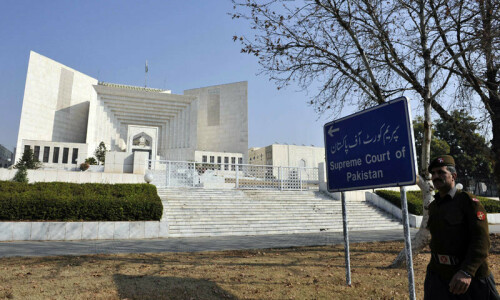
ISLAMABAD: The Supreme Court on Thursday ruled that a woman’s legal rights, personhood and autonomy were neither erased by marriage nor should they depend on it.
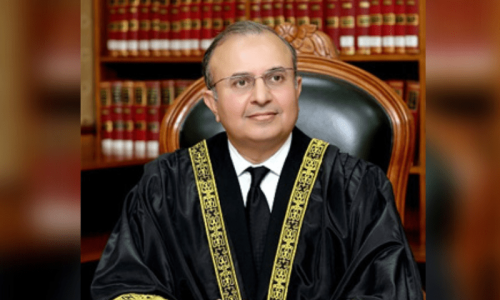
In a written judgement, Justice Syed Mansoor Ali Shah stated: “Any presumption that a married woman becomes financially dependent on her husband is legally untenable, religiously unfounded and contrary to the egalitarian spirit of the Islamic law.”
Leading a two-judge bench alongside Justice Athar Minallah, Justice Shah also delivered a clear directive by stating: “We deem it imperative to reaffirm that all judicial and administrative authorities have a constitutional duty to adopt gender-sensitive and gender-neutral language.”
The case at hand concerns the March 17, 2023 appointment of Zahida Parveen as a primary schoolteacher (BPS-12) at Government Girls Primary School, District Karak under the deceased’s son/daughter quota pursuant to Rule 10(4) of the Khyber Pakhtunkhwa Civil Servants (Appointment, Promotion, and Transfer) Rules 1989.
However, the district education officer withdrew the petitioner’s appointment order on May 15, 2023 without issuing a show cause notice and terminated her services through a clarification, which stipulates that the benefit of appointment under the deceased’s son/daughter quota was not available to a female who contracts marriage.
A further guidance/clarification was issued by the provincial government on April 28, 2023, providing that a married daughter may be considered eligible for appointment only if she has separated from her husband and become dependent on her parents.
Aggrieved, the petitioner filed an appeal before the KP government which was not responded to, leading her to challenge the impugned order in the Service Tribunal, which was dismissed on June 3, 2024 against which she moved the Supreme Court.
‘Structural flaw’
The exclusion of married daughters from the ambit of Rule 10(4) is not merely a procedural irregularity “it reveals a deeper structural flaw grounded in patriarchal assumptions about a woman’s identity and her role within the legal and economic order’’, observed Justice Shah in the nine-page judgement.
It presumes that upon marriage, a woman relinquishes her independent legal identity and becomes economically dependent on her husband, thereby forfeiting entitlements available to similarly situated male counterparts.
At its core, this exclusion constitutes a denial of a woman’s right to financial and economic independence — “rights that are not ancillary but essential to the exercise of constitutional personhood”, Justice Shah explained.
Women are autonomous, rights-bearing citizens in their own right, not by virtue of their relationship to a man, be it father, husband, or son, Justice Shah emphasised.
The apex court declared as discriminatory the exclusion of married daughters from compassionate appointment under Rule 10(4) through the impugned clarification and the April 28, 2023, letter. It declared that the clarification and the letter were ultra vires, issued without lawful authority and incompatible with constitutional guarantees.
The department was ordered to restore the petitioner’s appointment with all back benefits.
Concerned at language
The SC expressed concern over the language used in the impugned judgement, particularly the phrase “a married daughter becomes a liability of her husband”.
Such language is not only factually and legally erroneous but also deeply patriarchal, reinforcing outdated stereotypes that are fundamentally incompatible with constitutional values.
It assumes that a woman’s identity, legal capacity, personhood, and entitlement to support are subsumed into that of her husband upon marriage, treating her as a dependent rather than an autonomous, rights-bearing individual, the SC judgement said.
The use of gender-biased language by judicial or administrative bodies does not merely reflect prevailing social prejudices, it also legitimises structural discrimination and risks encoding bias into the law itself.
Globally, it has been recognised that the language of judicial reasoning plays a critical role in shaping, affirming, or undermining substantive equality, the judgement said, adding that as constitutional subjects, women were entitled to equality not only in result but also in the form, tone, and respect with which the law addresses them.
In this context, the Feminist Judgments Project undertaken in several jurisdictions, including Pakistan, has demonstrated how judicial reasoning can be reframed through a feminist lens, applying existing legal principles while eschewing gendered assumptions and incorporating inclusive, equality-affirming language, Justice Shah observed.
Internship programme
Meanwhile, the SC has announced that it “does not sponsor any seasonable internship for students of any institution, including Harvard Law School”.
The announcement said this is to caution the students to remain careful and report to the Registrar office if anyone comes across such malicious programme, also clarifying that the SC runs a yearly internship programme which was conducted through a proper process and handled by a Committee of senior Supreme Court judges.
Other than this, the SC does not sponsor nor own any internship programme, it said.
Published in Dawn, March 28th, 2025