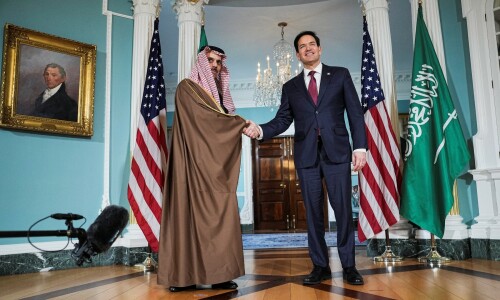
RIYADH: The United States and Saudi Arabia will sign a preliminary agreement to cooperate over the kingdom’s ambitions to develop a civil nuclear industry, US Energy Secretary Chris Wright told reporters in the Saudi capital Riyadh on Sunday.
Wright, who had met with Saudi Energy Minister Prince Abdulaziz bin Salman earlier on Sunday, said Riyadh and Washington were on a “a pathway” to reaching an agreement to work together to develop a Saudi civil nuclear programme.
Wright, on his first visit to the kingdom as secretary as part of tour of energy-producing Gulf states, said further details over a memorandum detailing the energy cooperation between Riyadh and Washington would come later this year.
“For a US partnership and involvement in nuclear here, there will definitely be a 123 agreement … there’s lots of ways to structure a deal that will accomplish both the Saudi objectives and the American objectives,” he said.
Riyadh previously did not want to sign a deal that would rule out possibility of enriching uranium
A so-called 123 agreement with Riyadh refers to Section 123 of the US Atomic Energy Act of 1954 and is required to permit the US government and American companies to work with entities in the kingdom to develop a civil nuclear industry.
Saudi authorities have not agreed to the requirements under the act, Wright said. It specifies nine non-proliferation criteria a state must meet to keep it from using the technology to develop nuclear arms or transfer sensitive materials to others.
Progress on the discussions had previously been difficult because Saudi Arabia did not want to sign a deal that would rule out the possibility of enriching uranium or reprocessing spent fuel — both potential paths to a bomb.
Saudi Crown Prince Mohammed bin Salman has long said that if Iran developed a nuclear weapon, Saudi Arabia would follow suit, a stance that has fuelled deep concern among arms control advocates and some US lawmakers over a possible US-Saudi civil nuclear deal.
Wright did not mention a wider arrangement with the kingdom, which the previous administration of US president Joe Biden had been seeking and included a civil nuclear agreement and security guarantees in the hopes it would lead to normalisation of relations between Saudi Arabia and Israel.
Saudi Arabia, the world’s largest oil exporter, is seeking to generate substantial renewable energy and reduce emissions, under the crown prince’s Vision 2030 reform plan.
At least some of this is expected to come from nuclear energy.
Published in Dawn, April 14th, 2025