• Inflows at Marala rise to 28,300 cusecs • Ex-Indus water commissioner says Delhi’s actions violate IWT, independent expert’s decision on Baglihar
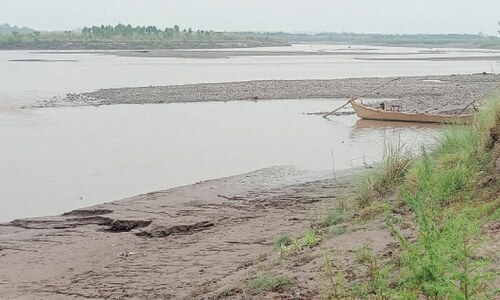
LAHORE: Flows in the River Chenab increased substantially on Tuesday — a day after they slowed to a trickle — after India ostensibly caved to international pressure over its illegal act of stopping river water from flowing to Pakistan.
Following its unilateral suspension of the Indus Waters Treaty, New Delhi had severely cut flows in the Chenab, which slowed from 34,000 cusecs on Sunday to around 3,000 cusecs on Monday.
The very next day, however, the situation improved, with inflows at Marala recorded at 28,300 cusecs on Tuesday.
“The situation started improving on Tuesday with discharge of water by India from up to downstream. Hope it will improve more in coming days if there is no halt on part of India,” a senior official told Dawn.
According to a report shared by the Pakistan Water and Power Development Authority, the inflows and outflows in Chenab at Marala were recorded as 28,300 cusecs and 19,100 cusecs respectively.
The inflows from Indus River at Tarbela were gauged as 95,300 cusecs, whereas the outflows were 50,000 cusecs.
The inflow of 37,000 cusecs was recorded at River Kabul at Nowshera, whereas the River Jhelum at Mangla was gauged as having inflows of 43,500 cusecs and outflows of 32,000 cusecs.
The water level in Tarbela dam, which has a minimum water operating level of 1,402 feet and a maximum conservation capacity of 1,550 feet, is currently at 1,444.30 feet. The live storage in the dam was recorded as 0.902 MAF on Tuesday.
With a current water level of 1,137 feet, Mangla dam recorded 1.235 MAF live storage. The minimum operating level of the dam is 1,050 feet, whereas the maximum conservation capacity is 1,242 feet.
Meanwhile, the Chashma reservoir recorded a live storage of 0.208 MAF with a current water level of 646.90 feet. The minimum operating level of the lake is 638.15 feet whereas its maximum conservation level is 649 feet.
International pressure
According to a senior official, who did not wish to be named, the reason behind the release of water a day after India had halting flows in the Chenab seemed to be pressure exerted from international quarters.
“All of India’s hydroelectric projects in the Chenab basin are run-of-the-river, which have reservoirs meant for power generation. They cannot hold waters in such reservoirs for more than 36 hours. But releasing water the very next day shows that they have done this after being pressed internationally,” the official explained. “I think India will not repeat this act again,” he hoped.
The official further said the related government departments in Pakistan are also monitoring the rivers’ flows very closely these days.
Talking to Dawn, former Pakistan’s Indus Waters Commissioner Syed Jamat Ali Shah termed the halting of flows in Chenab as a breach of the treaty, as well as a violation of the opinion of the neutral expert on Baglihar Dam.
“The neutral expert, in his decision, had termed maintenance of Baglihar dam necessary keeping in view the massive deposition of sand coming along with river water into the dam meant for power generation and not for water storage. However, according to verdict, the sand can only be flushed out when the water flows at Baglihar are recorded at 70,000 cusecs, which usually happens in the monsoon season only,” he explained.
Mr Shah said that such large quantities of water were not available, India apparently first flushed out the silt by opening spillways, and then closed them to start filling the dam.
Published in Dawn, May 7th, 2025