IT’S not the best time for Pakistan’s Supreme Court. In fact, it may well be the worst in three decades. For now, we go to the latest chapter in its year-long surrender: the ‘review’ filed against the court’s last worthy decision, ‘Sunni Tehreek vs Election Commission’.
To recap, the court had tried undoing the damage dealt to democracy by Qazi Faez Isa’s ludicrous bat symbol verdict, by returning winning parties their share of reserved seats. But that decision was ignored, the 26th Amendment passed, and the judicial branch carved into an armrest for the government.
Battle over, the state is now clearing away the wood shavings: it hopes to overturn the Sunni Tehreek decision and secure the Sharif-Bhuttos’ artificial majority in the assembly. For this, the review petition is its weapon of choice.
To be clear, a review isn’t an appeal: it’s meant to be heard by the same judges who authored the original verdict, which is why it’s usually thrown out. Even judgements wrong in law don’t merit review; that’s only for when an error is so wildly obvious, it can’t be ignored.
Standing alone is still better than surrendering together.
The bar is high for a reason: for the Supreme Court to be final, it’s more important that it have the last word than the best one — lest litigation go on forever, the law remain unsettled and chaos ensue.
It’s worse still if final verdicts are reversed in days rather than decades: this signals to litigants that personalities on the bench, or politics beyond it, are in play; that it would be best to game the system instead. Hence Justice Fazle Akbar holding, as far back as 1962, that “a decision of this court should be reopened with very great hesitation and only in very exceptional circumstances”.
But Justice Akbar could never have foreseen the era of Qazi Faez Isa (himself chief justice by the grace of a review verdict, mired in technicalities). Under the Isa court, the review became a way of life for rearguing entire cases, from public appointments to dissident voting. Some reviews were even framed as revisits, like lifetime disqualification. All succeeded. And all — whether one agreed with such reversals or not — had far poorer reasoning than the judgements they replaced.
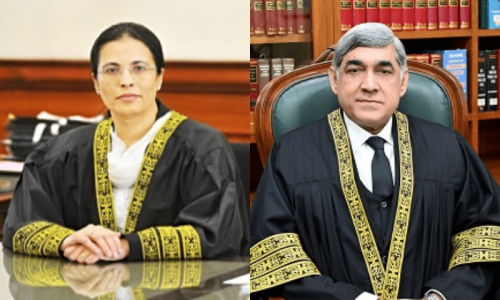
The state now seeks to do the same to the Sunni Tehreek verdict, via a review petition Justice Ayesha A. Malik has already seen fit to dismiss two Thursdays ago. Not that we could read her reasons: per new court policy still in the works, dissents or additional notes released before the final order won’t be uploaded. The worry is that the court may look disunited, or that debate may ensue.
Only, that’s entirely what dissent is for in common law countries: to raise awareness of the law, and to encourage public debate.
In fairness to the court’s conservatives, ill-timed orders have arrested democracy before: when the Bandial court was trying to enforce elections in 90 days, a string of unconvincing and incoherent dissents, primed to hamper the main ruling, streamed in. Then came the military trials case, with judges storming off the bench every which way, and the reserved seats decision, in which dissenters even cried against the judgement being implemented.
But that’s hardly cause enough: the main verdicts in all such cases have aged well, in both the law and the popular imagination. If they were defeated, it wasn’t just by dissenting notes, but by the regime of the day going to war with the courts — no judge can enforce the law when the entire state apparatus refuses to.
In which case, standing alone is still better than surrendering together; disagreements — written within the law — require publishing. Because yesterday’s dissent may become tomorrow’s majority: Cornelius’s lone stance against brute force in ‘Tamizuddin’ returned as a roar in Sindh High Court Bar Association.
It can also expose bad logic, like justice Nasir-ul-Mulk’s dissent against acquitting those accused of assaulting Mukhtaran Mai. Most of all, it allows judges to uphold their conscience and object on the record, as justice Khosa did to military trials of civilians a decade ago.
Finally, a petitioner deserves to know his argument was understood, even in defeat — that his day in court meant something. This past week, it was a two-man minority that sided with petitioner Jawwad S. Khawaja, and struck down military trials of civilians.
And that made all the difference: it’s taken the combined might of the bogus procedure law, a so-called constitutional amendment, and a second bench formed by justice Isa, to upend the landmark ruling from 2023.
Yet even after so much engineering, the final tally still stands at 7-5 — both verdicts taken together — 7-5, against military trials, within the same Supreme Court.
May dissents continue.
The writer is a barrister.
Published in Dawn, May 18th, 2025