
IN the subcontinent, these days, the smell of victory is in the air, which is usually just choked with pollution. And while Pakistan is confident the conflict ended while it was ahead, there is no dearth of views on the other side of the border which are also celebrating success.
In this age of noisy television channels, it is not difficult to proclaim success and fill the air with self-congratulations, ignoring opinions to the contrary.
And this celebratory air in India is the reason for the awareness in Pakistan that the bout may be over but the war certainly isn’t. Many in government and beyond are convinced the chances of another attack from India are high, though there may not be clarity on when it may be. This is also accompanied by the intent to prepare for it, in kinetic terms, by plugging whatever gaps were made visible recently or acquiring more advanced hardware. The whispers about an increased defence budget are a case in point. Pakistan is in no mood to waste any time.
However, there are also hints that this victory might lead to muscles being flexed internally as well. This was the message in some recent statements by officials as well as those who may not hold any position but are relevant only because “the powerful” speak in their throat, as the desi phrase goes.
Many in government and beyond are convinced the chances of another attack from India are high.
For instance, eyebrows were raised over the recent statement by the DG ISPR about Mahrang Baloch in a press conference, which came in reply to a question. Indeed, there is no doubt that with recent tragedies, such as the attacks on the APS school bus and the Jaffar Express, there has been a general hardening of views against the militants and the dissident voices in Balochistan. But whether this merits a narrow approach to the province where only the state muscle is used is not entirely wise counsel. However, statements by provincial government officials as well as the one described above suggest that the mood is combative.
But the belligerent mood might not only be for the hapless people of Balochistan. An iron glove is also aiming for PTI. One dire prediction on television has the PTI parliamentarians disqualified in the May 9 cases and their seats won by others. Another official soothsayer has taken potshots at ‘liberals’, apparently all those who somehow ‘support’ terrorism in Balochistan.
While these are statements on perhaps a platform not known for entirely serious conversations, they do lend credence to the analysis that the conflict with India will strengthen the establishment’s hand domestically. And this strengthening will allow a short leap to the conclusion that the moment is ripe to address the long-standing challenges within.
One, this is easier said than done. If all that was needed to resolve these issues was more force and a harder resolve, the strategy of the past would have shown some result, instead of simply complicating matters. This is true of the past decades in Balochistan; this also holds for PTI in the past few years as well, and other issues. It is precisely because there is no simple solution (including state coercion or violence) that challenges remain without any resolution in sight.
Second, it is worth asking if it is the time now to again pick at existing wounds and make them bleed some more. If the government’s assessment is to be believed of another attack from India, then there is all the more reason to create internal harmony and focus on the threat without, rather than expend energies and resources battling dissent at home.
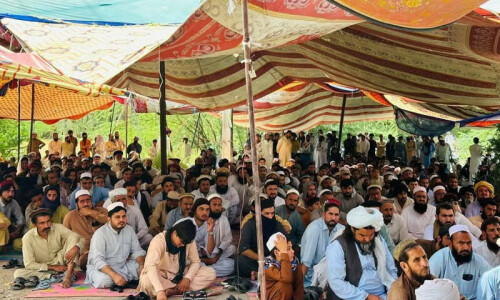
And this is not simply a matter of resources alone; if the establishment is rightly assuming the recent conflict has led to goodwill and support for it, it can’t not realise this can evaporate rapidly too if arrests, raids, and violence resume. The memories of a victory, however recent, might not prove stronger than living experiences of what is seen as injustice. This can perhaps be seen to be at work with regard to the incident in Waziristan.
And if the strong-arm tactics begin, so will the conversation about them and this will allow many, including enemies, to assume weaknesses in one’s defences.
It is also worth remembering that in this day and age, blocking unpalatable news from media outlets does not really stem the flow of information. And while we are rightly happy about the world having found new respect for Pakistan with this conflict, let’s not forget that a series of stories about crackdowns on citizens or in provinces will outnumber the stories on air superiority — even if the world is no longer focused on democracy or human rights, we have to distance ourselves from the image of a dysfunctional state. That is a job far from over.
Fourth, it is worth noting that these short, sharp conflicts that India is now assuming is the ‘new normal’ will bear a heavier burden for Pakistan than the other side. That India is aware of it is no secret. If Pakistan is to prepare for them in the coming years, other than military preparedness, the economy also has to be in a stronger position. Wars are expensive business.
And, as the past seven to eight years have shown, political bickering and instability do not allow for reform and a better economy, despite what the government and IFIs are claiming. Recent years have shown again and again that every possible political setup, party and one-page equation has not done well beyond stabilisation. And this will make the threats without the hardest to manage.
Perhaps it is time to renew the debate on why economic reform has failed and why political stability is needed to make it succeed. And what this stability looks like. If not for the welfare of the people of Pakistan but for the wherewithal to succeed in conflicts. It is simply no longer enough to agree that the economy needs to improve but to ask why all efforts to do so have failed so far. It is time for some hard and unpalatable conversations.
The writer is a journalist.
Published in Dawn, May 27th, 2025