
Nestled in the green heart of West Yorkshire in the UK, Bradford was once powered by the textile industry. Today, it’s a city transformed — shaped by new voices, cultures, and creative energy.
From the mid-20th century onwards, waves of immigration — especially from Pakistan, India and Bangladesh — reshaped the city’s cultural DNA, much like many other parts of England. By the 1980s, Bradford had become a vibrant mosaic of languages, faiths, cuisines and traditions. The mills may have fallen silent, but the voices they brought endure in the city’s architecture, its festivals, its food and, above all, in its collective memory.
It is from this rich historic rhythm that Tower of Now arises — an artistic monument that embodies Bradford’s evolving pluralism. Saad Qureshi who conceived it is a celebrated diasporic visual artist. Saad was born in the Pothohar plateau region of Punjab in Pakistan, arrived in Bradford first as an immigrant and is now based in Oxford. The sculpture is both homage and disruption to him. It does not simply reflect the city’s diversity; it reconfigures it, elevating it into a vertical emblem of shared identity.
Commissioned as part of Bradford’s designation as UK City of Culture 2025, the tower becomes more than an artwork. It becomes an emblem — a visual signature of a city in motion. In Qureshi’s own words, it gestures toward a New Britishness — a layered, relational and evolving idea of identity, born not from purity but from complexity.
A British-Pakistani artist’s awe-inspiring creation envisions a world of religious and cultural coexistence
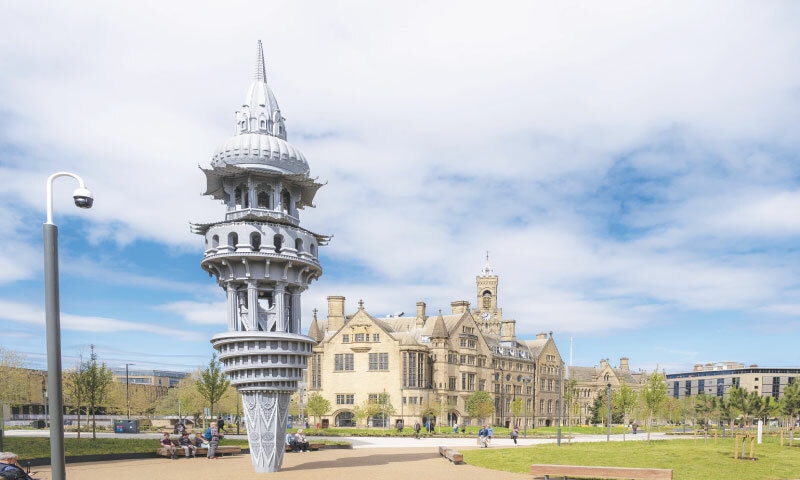
Constructed from an assemblage of sacred architectural fragments, Tower of Now merges the symbolic with the surreal. Minaret segments, Hindu temple spires, Gothic steeples, Islamic arches, Jewish synagogue elements, Roman pillars, pagoda-style roofs and onion domes — that recall Byzantine and Indo-Islamic architecture — all rise in dialogue cohesively. The base narrows like a rocket or totem pole, blending futuristic silhouettes with tribal motifs to suggest propulsion through time and culture.
Cast in grey, the tower carries an otherworldly presence. Drawing inspiration from the biblical Tower of Babel, Qureshi subverts the narrative: what was once a story of confusion becomes, here, a metaphor for creative convergence. This is not a monument to hubris but a celebration of plural being.
As the French philosopher Paul Ricoeur argues in Oneself as Another, identity is not a fixed essence but a narrative shaped through our interpretive engagement with cultural symbols, memory and others. In Tower of Now, these symbols — rendered in wood, metal, fiberglass and plaster do not jostle for space — they speak. Rather than diluting one another, their dialogue forges a composite civic self.
From South Asia, poet-philosopher Muhammad Allama Iqbal reminds us that true selfhood emerges not through imitation, but through spiritual assertion. This 15 metre tall sculpture, with its assembled complexity and vertical ambition, embodies gestures upward, not to escape difference, but to unite it in elevation. Moreover, often attributed to Rabindranath Tagore, the quote “The soil, in return for her service, keeps the tree tied to her; the sky asks nothing and leaves it free”, may not appear in his formal writings, yet it resonates deeply with his philosophical outlook.
Bradford carries its share of friction, complexity and unfinished business. Yet the power of Qureshi’s sculpture lies in its refusal to simplify — standing as a piece of utopian reality. It does not flatten difference; it stacks it. Each fragment represents a community, a lineage, a faith and, still, they hold together. The structure’s verticality symbolises a unity that does not erase but composes — a kind of civic chord made of many notes.
Located within sight of the Alhambra Theatre and the City Hall, Tower of Now neither dominates nor retreats from its surroundings. It participates. Its silhouette doesn’t declare conquest; it suggests kinship. It invites all who see it to ask: what might a truly coexistent city look like — not in theory, but in form?
Tower of Now rises as a physical reminder that identity is never still. It’s a living process, not a label. Bradford’s communities, with all their stories and struggles, are not just part of British culture — they are British culture. In cities such as Bradford, we see the future of the UK in action: young people blending heritage and innovation, communities crossing invisible lines to create new culture. This is what the New Britishness looks like — not polished perfection, but honest involvedness.
Tower of Now is on display
at Hall Ings in Bradford from
April 25, 2025-April, 2026
The writer is an art critic, curator and an associate professor (currently on sabbatical) at the Department of Visual Communication Design at Beaconhouse National University, Lahore. He spends his time in-between Birmingham and Lahore. He can be reached at aarish.sardar@gmail.com
Published in Dawn, EOS, June 6th, 2025