World ‘less safe’ after escalation in Subcontinent, says Bilawal


• Ex-foreign minister says threshold for war in South Asia ‘lowest it’s ever been’; his stark assessment highlights tenuous nature of ceasefire
• Calls on US to help bring New Delhi to negotiating table after Trump acknowledges presence of ‘strong leadership’ in Islamabad
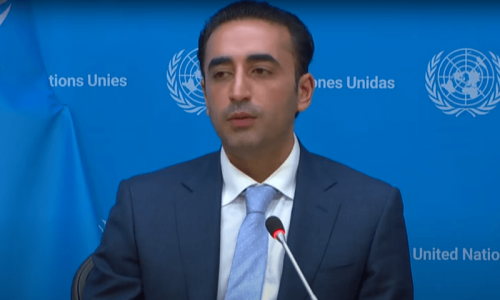
WASHINGTON: Warning that the current ceasefire between India and Pakistan was quite tenuous, former foreign minister Bilawal Bhutto-Zardari has said that the world is now a less safe place than it was before the crisis in the Subcontinent.
The statement comes a day after US President Donald Trump acknowledged the presence of “very strong leadership” in Islamabad as being one of the contributing factors to a recent de-escalation of tensions with India.
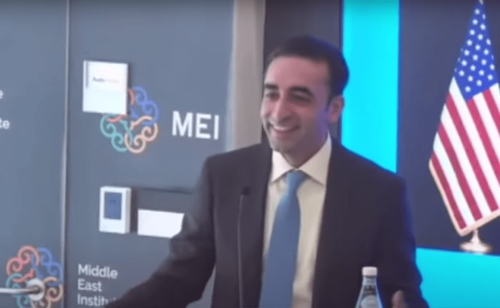
In meetings with US lawmakers and think tanks, the PPP chief, who is currently heading a high-powered Pakistani delegation to the US, said the ceasefire was “a welcome start”, but cautioned that “South Asia, India, and Pakistan, and by extension, the rest of the world, are less safe today than when we started this crisis.”
In contrast with efforts of India’s national security caucus, the Pakistani delegation currently in Washington pursued a focused but quieter diplomatic effort on Capitol Hill this week.
The delegation’s meetings with senior US lawmakers — members of the House Foreign Affairs Committee and key senators — underscored Pakistan’s effort to sustain a credible narrative amid a tilt towards New Delhi in US policy circles.
Mr Bhutto-Zardari held candid and constructive meetings with US Congressman Brian Mast, Chairman of the House Foreign Affairs Committee; Congressman Gregory Meeks, Ranking Member; Congressman Bill Huizenga, Chair of the Subcommittee on South and Central Asia; and senior lawmaker Brad Sherman.
Central to the delegation’s message was the unilateral suspension of the Indus Waters Treaty by India, described by Mr Bhutto-Zardari as “a dangerous precedent and a violation of international law.”
The potential weaponisation of water resources adds a new and alarming dimension to the already fragile peace framework between the two nuclear-armed neighbors, he said.
“The threshold for all-out war between India and Pakistan is the lowest it has ever been in our history,” he stated, adding: “As it stands today, if there’s a terrorist attack anywhere in India, proof or no proof, it means war”.
This reality underscores the urgency for sustained diplomatic engagement to prevent miscalculations that could lead to full-scale conflict.
He urged the United States to leverage its influence, stating, “The United States, if it puts its might behind peace, can speak to India and explain how it’s in all our interests to resolve our issues, including the core issue of Indian Illegally Occupied Jammu and Kashmir.”
This aligns with President Trump’s messaging as well. Speaking to reporters after an interaction with German leader Freidrich Merz in the Oval Office a day earlier, Trump had categorically claimed credit for talking India and Pakistan back from the brink by threatening to pull out of trade talks, which he claimed both countries were currently engaged in with the US.
“They don’t give me credit for anything, but nobody else could have stopped it,” he said, referring to the recent escalation in the Subcontinent.
Pakistan House reception
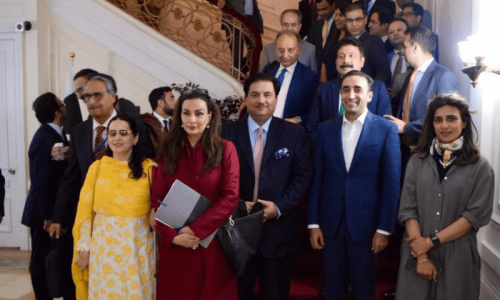
The Pakistani delegation also engaged with a bipartisan group of US legislators at a dinner reception hosted by Ambassador Rizwan Saeed Sheikh at Pakistan House.
The event saw the attendance of members of Congress, including Representatives Jack Bergman, Tom Suozzi, Ryan Zinke, Maxine Waters, Al Green, Jonathan Jackson, Hank Johnson, Stacey Plaskett, Henry Cuellar, Mike Turner, Riley Moore, George Latimer, and Cleo Fields, among others.
Addressing them, Mr Bhutto Zardari presented a compelling case for regional peace and stability, characterizing the delegation’s visit as a “mission for peace.”
“Our Prime Minister, Muhammad Shehbaz Sharif, gave this delegation a mission, and the mission is peace — to engage in dialogue and diplomacy with India to resolve our issues,” stated Mr Bhutto-Zardari.
Appreciating the crucial role played by the United States in facilitating a ceasefire between the two nuclear-armed nations, the former foreign minister urged US legislators to continue their efforts in maintaining peace and stability in South Asia.
“We’re here to appeal to you, requesting the United States to aid us in this pursuit for peace. The United States, if it puts its might behind peace, can speak to India and explain how it’s in all our interests to resolve our issues, including the core issue of Indian Illegally Occupied Jammu and Kashmir (IIOJK),” the Chairman noted.
“Just as urgently as we needed the United States government’s help to achieve the ceasefire, we need your assistance today to help engage India and prevent policies that lead to regional and global insecurity,” he said.
The US Congress members assured their full support for regional peace and stability in South Asia, commending the delegation for their comprehensive briefing on the ongoing crisis.
Published in Dawn, June 7th, 2025