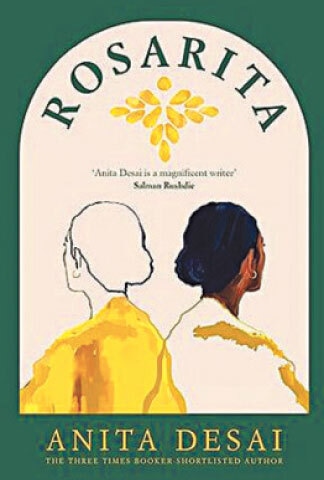
Rosarita
By Anita Desai
Picador
ISBN: 978-1035044436
96pp.
Anita Desai, a veteran of Indian English literature, has spent over six decades exploring the inner worlds of her characters, often focusing on Indian women navigating repression and expectation. Known for her evocative use of imagery and her interest in cross-cultural themes, Desai writes with a psychological and emotional depth about her protagonists.
Her latest novel, Rosarita, continues that tradition, with a quietly disorienting narrative that examines the fractures between memory and reality, duty and desire, the past and the self.
Set primarily in the Mexican town of San Miguel de Allende, Rosarita follows Bonita, a young Indian woman studying Spanish. The story opens in a local park, where Bonita is approached by a stranger, an older woman dressed in festive Mexican attire, who claims to have known her deceased mother, Rosarita.
The stranger, who later comes to be known as Vicky or “the Trickster”, tells Bonita that her mother once studied art in San Miguel. This claim unsettles Bonita, who has no memory of her mother ever painting, let alone travelling abroad. She does, however, remember a faded painting from her childhood, unsigned and mysterious, of a woman and a child on a park bench, perhaps even in this very town.
Anita Desai’s latest novel offers a quiet, meditative work that reflects on the limits of knowledge and memory
As Bonita begins to question the official version of her mother’s life, she embarks on an emotional and psychological journey to piece together what might have been. Her search is coloured by memories of her childhood in Old Delhi, where she lived with her paternal grandparents during her mother’s unexplained absence.
Her grandmother was a quiet, housebound figure, long-suffering under the authority of her husband. In contrast, Bonita’s mother re-emerges later in the child’s life as a woman unwilling to protest domestic conventions but also distant, shadowed by her own choices. These recollections inform Bonita’s desire to study languages — French, Portuguese and Spanish — as an effort to avoid a similarly constrained future.
The novel’s most poignant section imagines what may have prompted Rosarita to travel to Mexico. In Bonita’s mind, it begins with a harrowing lecture on parallels between the Indian Partition and the Mexican Revolution. Images of trains filled with slaughtered passengers trigger something unresolved in her, possibly connected to her family’s past. Bonita begins to wonder if her mother’s journey was an attempt to escape her inherited trauma, to seek an identity outside the roles assigned to her.
Desai crafts this narrative in a distinctive second-person voice. This allows the reader to delve into Bonita’s thoughts, drawing readers into her uncertainty and hesitation. The present-tense narration heightens the closeness of her emotional interactions, particularly with Vicky. Because of this proximity between the character and the reader, the author manages to reinforce a sense of disorientation that defines Bonita’s search. It works well at times, though it can fuel estrangement when the emotional tension does not fully resolve.
The book’s tone is restrained, drifting between the introspective and the fable or folklore. There is a ghostly quality to the stranger’s accounts of Rosarita’s life, one that Desai deliberately leaves open to interpretation. The unreliable narration, both from Vicky and from Bonita’s own memories, creates a tension that holds through much of the novel. This ambiguity mirrors the core theme: how much of someone else’s story, even a mother’s, can truly be known?
Characterisation in Rosarita is subtle. Bonita, while central to the narrative, is not deeply transformed by its end. Her journey is one of searching rather than resolution. We see her drawn into the possibility of discovering her mother’s hidden life, yet we never quite see her reach firm conclusions. Some readers may find this lack of closure unsatisfying, particularly when so much of the narrative teases the promise of revelation. While the portrayal of Vicky adds colour and a sense of mystery, her evolving unreliability becomes a tool that stretches perhaps a little too long without deeper payoff.
That said, the book is not about solving a mystery as much as it is about sitting with uncertainty. Desai’s prose remains precise and attentive throughout, filled with visual details that ground the reader even as the storyline drifts into the elusive. A park bench, an unfinished painting, the texture of a remembered afternoon, these are the markers of a novel more interested in emotional landscapes than plotted arcs.
For South Asian readers, Rosarita offers both familiarity and distance. The themes of duty, tradition, female autonomy and generational silence resonate with the experiences of many in the region. The backdrop of Partition is evoked not through direct storytelling but through memory, showing how history can shape lives in indirect, often invisible ways. Bonita’s questioning of her mother’s choices, framed within the larger structure of family, marriage and societal expectations, echoes conversations still ongoing in many South Asian homes today.
At the same time, the novel’s Mexican setting and the figure of the Trickster broaden the scope beyond national boundaries, creating a space that connects experiences of women across cultures. Rosarita’s journey is both specific and universal, a tale of escape, reinvention and the personal cost of reclaiming identity.
Rosarita is a novel that invites patient reading. It is not driven by plot, but by atmosphere, memory and the complex intergenerational experience. While it may leave some questions unresolved, that ambiguity is part of its point. Anita Desai offers a quiet, meditative work that reflects on the limits of knowledge.
Readers looking for clarity may not find it here, but those open to lingering in the in-between will appreciate the novel’s gentle probing into what it means to belong: to a family, to a past, and to oneself.
The reviewer is a content lead at a communications agency.
She can be reached at sara.amj@hotmail.co.uk
Published in Dawn, Books & Authors, June 15th, 2025