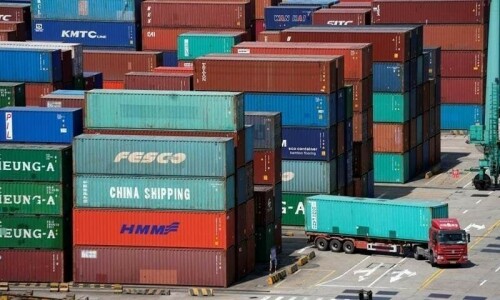
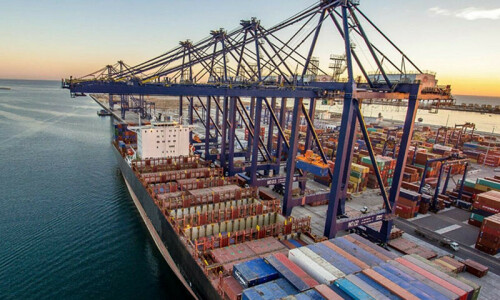
KARACHI: India’s attempt to disrupt Pakistan’s external trade by banning ships carrying Pakistani goods from anchoring at its ports has failed to yield the desired impact, according to shipping industry representatives.
On May 2, India imposed a ban on ships carrying goods originating from or destined for Pakistan, barring them from entering Indian ports or transiting through Indian territory. The move followed military aggression under ‘Operation Sindoor’ launched on May 7, which ended within four days due to Pakistan’s forceful retaliation.
While India initially sought to hurt Pakistan’s trade flows, the outcome fell short of expectations. Shipping companies reportedly adapted by separating cargo bound for and from Pakistan, thereby avoiding dependence on Indian ports.
Importers, however, said the Indian ban has resulted in longer shipping times and higher freight charges.
“Mother vessels are not coming to Pakistan due to this Indian action, which delays our imports by 30 to 50 days,” said Javed Bilwani, President of the Karachi Chamber of Commerce and Industry. He added that importers are now relying on feeder vessels, which raises costs.
Shipping delays push up costs, but exporters report minimal impact on overall trade
Exporters also reported a spike in shipping and insurance costs following the Indian aggression. However, they said the overall impact on exports remains minimal.
“There is no significant impact on exports after the Indian aggression, except for a rise in insurance costs. Shipping charges had already gone up even before the escalation,” said Aamir Aziz, an exporter of textile made-ups.
Pakistan’s exports are heavily reliant on imported inputs for value addition. With the government maintaining tight controls on imports to conserve foreign exchange, any disruption in supply chains has broader economic implications.
However, Pakistan Ship’s Agents Association Secretary General Syed Tahir Hussain dismissed claims that mother vessels have stopped calling at Pakistani ports.
“You can see mother vessels at Karachi and Port Qasim,” he said. “Feeder vessels are also sufficient to handle Pakistan’s trade volume, as they can carry between 6,000 and 8,000 containers — well above the current level of our exports and imports.”
Trade with India
Formal trade relations between Pakistan and India have remained frozen since 2019. Bilateral trade declined from $2.41bn in 2018 to $1.2bn in 2024. Pakistan’s exports to India decreased from $547.5 million in 2019 to just $480,000 in 2024.
Nevertheless, unofficial trade is thriving. Al Jazeera, quoting the India-based Global Trade Research Initiative (GTRI), reported last month that unofficial Indian exports to Pakistan are estimated at $10bn per year.
This parallel trade has been facilitated through alternate routes, including ports in Dubai (UAE), Colombo (Sri Lanka), and Singapore.
India’s exports include pharmaceuticals, petroleum products, plastics, rubber, organic chemicals, dyes, vegetables, spices, coffee, tea, dairy items, and cereals. Pakistan’s key exports to India consist of copper, glassware, organic chemicals, sulphur, fruits and nuts, and certain oilseeds.
Published in Dawn, June 29th, 2025