DG ISPR brands Indian NSA Ajit Doval ‘chief architect’ of terrorism in Pakistan
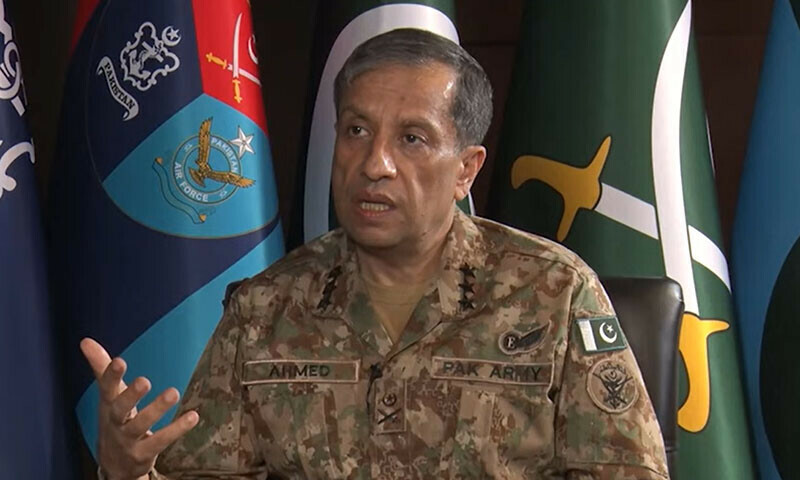

Inter-Services Public Relations (ISPR) Director General Lt Gen Ahmed Sharif Chaudhry on Wednesday accused Indian National Security Adviser Ajit Doval of being the “chief architect” of terrorism in Pakistan.
The interview comes amid tensions between the two nuclear-armed countries in the wake of their recent military confrontation, sparked by New Delhi’s baseless allegations against Islamabad over a deadly attack in occupied Kashmir’s Pahalgam.
During an exclusive interview with Qatari broadcaster Al Jazeera, the military’s spokesperson branded Doval the “evil chief architect of India’s terror enterprise” and accused him of being responsible for not only acts of terrorism in Pakistan, but also terrorism within the region and transnational killings.
“Do you think it’s happening on its own? This terror enterprise cannot be sustained without the sponsorship of India,” the DG ISPR said. “Who is the chief architect? Mr Ajit Doval.”
According to the ISPR chief, India provided funding, planning, intelligence and technical support to terrorist groups within Pakistan, such as Fitna-al-Khawarij and Fitna-al-Hindustan.
In July last year, the government designated the banned Tehreek-i-Taliban Pakistan (TTP) as Fitna-al-Khawarij, while mandating all institutions to use the term khariji (outcast) when referring to the perpetrators of terrorist attacks on Pakistan.
In May this year, the government designated all terrorist organisations in Balochistan as Fitna al Hindustan — a new phrase aimed at framing India’s alleged role in terrorism as a deliberate destabilisation strategy, potentially to galvanise domestic support.
“The strategy of India is to keep Pakistan embroiled in this menace of terrorism, so that its true power … potential is not realised,” Lt Gen Chaudhry said. “The power differential between the two countries keeps increasing, so that India can act as a regional hegemon, a bully and can dictate its own terms.”
He added that this strategy of supporting terrorists in the region went as far back as 1971, when India supported the Mukti Bahini in East Pakistan.
“Indians have acknowledged it — PM [Narendra] Modi went on record not only acknowledging but boasting about it.”
The military’s spokesperson then added that terrorist commanders who had surrendered or been captured confessed that they received support from New Delhi, citing press conferences by captured Fitna-al-Hindustan commanders and the case of captured Indian Navy Officer Kulbhushan Jadhav.
“This evidence is all public. It is RAW,” he said, referring to India’s spy agency, Research and Analysis Wing.
“And not only are they using men, they are also exploiting the Baloch women for these nefarious purposes.”
‘A reckless and irresponsible state’
Lt Gen Chaudhry further said that Pakistan was “not a reckless and irresponsible state like India”, blaming external actors for internal issues.
“We must understand that terrorism is an internal problem of India as a result of the continuous oppression which India does to its minorities as part of its policy,” he said. “Rather than addressing these grave injustices, inequalities, and doing soul searching, it (India) is very quick to put all the blame on Pakistan.
“Because of this senseless blame game that the Indians are resorting to, it is bringing the thresholds between India and Pakistan to dangerously low levels, to such levels that where one incident of terrorism or an act of violence can be turned into an act of war.”
The ISPR chief warned that such an approach was putting the lives of over 1.6 billion people “in the hands of non-state actors” who had an interest in Pakistan and India going to war.
“We are an established and declared nuclear power, and the world has no experience of going to or even attempting to go into a misadventure against an established nuclear power,” Lt Gen Chaudhry said.
“If such a misadventure is taken or attempted, then it will lead to horrific consequences which the world may not be able to endure.”