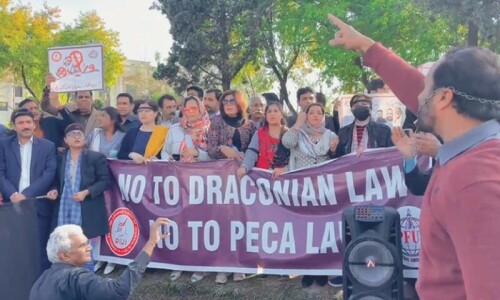
THE order by an Islamabad judge to take down 27 YouTube channels is only the latest example of how Peca continues to be weaponised to silence critical voices. Despite repeated assurances by the authorities that Peca would not be used to target journalists or censor dissent, the law has once again been invoked — this time under the vague pretext of curbing “fake, misleading and defamatory” content.
Among those affected are independent journalists, political analysts, and the official PTI account. The move appears to be less about safeguarding national security and more about controlling the narrative. As per court documents, the blocked channels were allegedly engaged in defamation, disinformation and provoking ill-will towards state institutions.
Yet, no clear definitions of what constitutes ‘fake news’ or ‘defamation’ appear to have been provided. Sweeping accusations, along with the invocation of national security, have once more exposed just how broadly and arbitrarily Peca is being applied.
Independent journalism in Pakistan is already under threat. The authorities have consistently failed to distinguish between criticism of government policy and attacks on the state itself. Almost any criticism is instantly labelled as anti-state activity. This conflation is dangerous. Holding the government, military or judiciary accountable through peaceful means — including digital platforms — is a constitutional right. It is neither sedition, nor subversion.
The newly rebranded National Cyber Crime Investigation Agency, much like its predecessor, appears to be more focused on policing speech than addressing real cybercrime. Section 37 of Peca, under which this action was taken, continues to function as a legal bludgeon against dissent. International watchdogs, local media unions and digital rights activists consistently warn that such actions violate Pakistan’s obligations under international human rights law.
It is alarming what precedent this sets for future online censorship. If content can be taken down solely on the state’s interpretation of intent, no independent voice is safe. It also places tech platforms like YouTube in a precarious position, forcing them to comply with vague legal orders or risk state retaliation.
If there is truly defamatory content, why not seek legal recourse under the Defamation Ordinance? Why enforce blanket bans? Such bans should be lifted and the misuse of Peca must end. A country cannot legislate its way out of political discontent, and silencing opposition will only deepen public mistrust.
Published in Dawn, July 10th, 2025