DAMASCUS: A Syrian diplomatic source said on Saturday that a US-mediated meeting with Israeli officials in Paris this week sought to “contain the escalation” after recent sectarian violence in southern Syria prompted Israeli intervention.
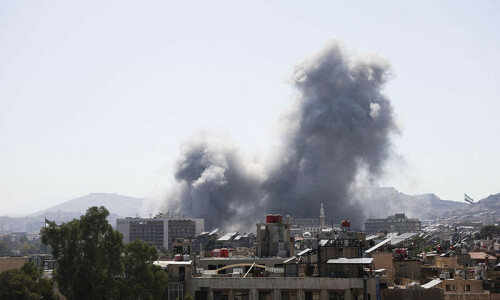
Israel launched strikes this month on Damascus and Druze-majority Sweida province, saying it was acting both in support of the religious minority and to enforce its demands for a demilitarised southern Syria.
The Syrian diplomatic source told state television on Saturday that the recent Paris meeting “brought together a delegation from the foreign ministry and the general intelligence service with the Israeli side”, and addressed “recent security developments and attempts to contain the escalation in southern Syria”.
On Thursday, US special envoy for Syria Tom Barrack had said he held talks with unspecified Syrian and Israeli officials in Paris.
A senior diplomat had previously said that Barrack would be facilitating talks between Damascus’s Foreign Minister Asaad al-Shaibani and Israeli Strategic Affairs Minister Ron Dermer.
Diplomatic sources see possibility of reactivating disengagement agreement with international guarantees
According to the source cited by state TV, the meeting “addressed the possibility of reactivating the disengagement agreement with international guarantees, while demanding the immediate withdrawal of Israeli forces from points where they recently advanced”.
After the overthrow of longtime Syrian ruler Bashar al-Assad in December, Israel sent troops into a UN-patrolled buffer zone that used to separate the countries’ forces in the strategic Golan Heights.
It has since conducted incursions deeper into southern Syria, demanding the area’s total demilitarisation. Damascus had previously confirmed holding indirect contacts with Israel seeking a return to the 1974 disengagement agreement that created the buffer zone.
The Paris meeting “did not result in any final agreements but rather represented initial consultations that aimed to reduce tensions and reopen communication channels in light of the ongoing escalation since early December”, the diplomatic source said.
Toll tops 1,400
More meetings were planned, the source said, adding that the Syrian side had emphasised that the country’s unity and sovereignty were non-negotiable. “Sweida and its people are an integral part of the Syrian state,” the delegation said, according to the source.
The week of clashes in Sweida, which began on July 13, initially involved Druze fighters and Bedouin tribes, but government forces intervened on the side of the latter, according to witnesses, experts and the Syrian Observatory for Human Rights monitor.
The Observatory said on Saturday that the violence had killed more than 1,400 people, the vast majority in the week between July 13 and a ceasefire last weekend.
It said the dead included 928 Druze, 533 of them fighters and 395 civilians, 250 of whom were “summarily executed by defence and interior ministry personnel”.
The toll also included 428 government security personnel and 43 Sunni Bedouin, three of them civilians who were “summarily executed by Druze fighters”, according to the Britain-based Observatory, which relies on a network of sources inside Syria.
Another 15 government personnel were killed in Israeli strikes, it added.
Syrian and Israeli officials had previously met in Baku on July 12, according to a diplomatic source in Damascus, coinciding with a visit to Azerbaijan by Syria’s interim President Ahmed al-Sharaa. The two countries have technically been at war since 1948, and Israel has occupied the Golan Heights, which it seized from Syria, since 1967.
After Assad’s ouster, Israel carried out hundreds of air strikes in Syria to prevent key military assets from falling into the hands of the new Islamist-led administration.
Published in Dawn, July 27th, 2025