Pakistan successfully launched a remote sensing satellite from a launch centre in China on Thursday that aims to strengthen Pakistan’s agricultural monitoring and disaster management, among other capabilities, according to a Foreign Office statement.
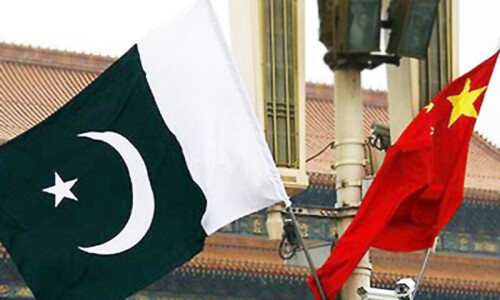
Pakistan has held strong bilateral relations with China which has supported it through many investments and development projects such as the China-Pakistan Economic Corridor (CPEC), termed as a “lifeline” for the country’s economy.
“In a major milestone for space exploration and technological progress, Pakistan today successfully launched its Remote Sensing Satellite from the Xichang Satellite Launch Centre (XSLC) in China,” a statement by the foreign ministry said.
The satellite was launched by Pakistan’s national space agency, the Pakistan Space and Upper Atmosphere Research Commission (Suparco), in collaboration with the China Electronics Technology Group Corporation (CETC) and Microsat China, according to the ministry.
According to the statement, the satellite “will provide high-resolution, round-the-clock imaging, significantly strengthening Pakistan’s capabilities in urban planning, infrastructure development, disaster management and mitigation, agricultural monitoring, food security, environmental protection, deforestation tracking, climate change analysis, and water resource management”.
The ministry said that the satellite represented a “cornerstone of an integrated Earth observation system”.
“With this latest success, Pakistan reaffirms its position among the community of space-faring nations, leveraging innovation to pursue a more secure, sustainable, and prosperous future,” it added.
Deputy Prime Minister Ishaq Dar commended the dedication of the engineers, scientists, and technical teams from Suparco, CETC and Microsat China for their “exemplary cooperation and unwavering commitment to the mission”.
Planning Minister Ahsan Iqbal also congratulated the nation and the Suparco team on the successful launch of the satellite.
“We are deeply grateful to China for its unwavering support and cooperation in this project,” he said.
He confirmed that the satellite had successfully entered its designated orbit and would soon begin delivering data.
“We are committed to restoring Pakistan’s leadership in space technology,” Iqbal added. “With China’s help, we plan to send a Pakistani astronaut into space next year. By 2035, we will also successfully complete our lunar mission and land on the moon.”
In a post on X, Prime Minister Shehbaz Sharif congratulated Suparco on the successful launch and thanked Chinese partners for their contributions to the project.
“This achievement showcases the soaring heights of Pakistan-China cooperation, extending beyond borders and into outer space, driven by a shared vision to harness space technology for the betterment of humanity,” the PM wrote.
“The satellite will have wide-ranging benefits for CPEC as well as applications for use in agriculture, urban planning, disaster management, mapping of transportation networks and data acquisition in different environments.”
President Asif Ali Zardari also congratulated the Pakistani scientists on successful launch of remote sensing satellite, saying, “Pakistan is proud of the capabilities of its scientists.”
He called the milestone “a bright symbol of Pakistan’s growing space capabilities”, extending his gratitude to the Chinese government for its cooperation in the successful launch of the satellite.
Suparco Chairman Mohammad Yousaf Khan said that the new satellite would serve national priorities and “contribute meaningfully” to Pakistan’s sustainable socio-economic development.
China’s space programme has rapidly advanced over the years, achieving milestones like the Tiangong space station and lunar sample-return missions. Its BeiDou satellite system and reusable rocket development underscore growing technological prowess.
In April, PM Shehbaz expressed Pakistan’s desire to enhance cooperation with China in the field of space technology, adding that China remained the country’s “most reliable and strategic partner”.
In May, Pakistan became the first foreign nation to join China’s space station training programme, sending two astronauts for training under a landmark agreement with the China Manned Space Agency.