
“THE population is the prize.” Those familiar with counterinsurgency warfare theories will recognise the context in which David Galula coined this phrase. Galula argued that insurgency is not a military contest but a political struggle, in which both insurgents and counterinsurgents vie for the population’s support and allegiance.
Recent developments in Bajaur, where citizens are protesting against military operations and the tragic events in Tirah Valley last week, when five demonstrators were killed after security forces allegedly opened fire, must be viewed through this lens. These incidents suggest an urgent need for the state to reassess its counterterrorism (CT) strategies, which appear increasingly detached from the goal of winning hearts and minds.
In his seminal book Counterinsurgency Warfare: Theory and Practice, Galula emphasises that military force must be subordinate to political objectives. Force used without legitimacy alienates civilians and reinforces the insurgents’ narrative. It is essential to remember that insurgents do not need to win militarily; they only need to survive, avoid defeat, and steadily erode the state’s credibility in the eyes of its people.
Militants in KP’s tribal districts have been challenging the state for the past two decades. Despite numerous operational successes, security forces remain engaged in prolonged conflict, arguably with little substantive change in their tactics or strategic orientation. The prevailing operational approach remains focused on achieving military victories while largely neglecting the critical objective of winning the population’s allegiance.
This strategic oversight not only deepens mistrust among the local population but also fosters suspicion towards the counterinsurgent forces themselves, ironically serving the militants’ very aim of delegitimising the state’s presence and actions.
A lasting solution to insurgency lies not in overwhelming military force but in political strategy.
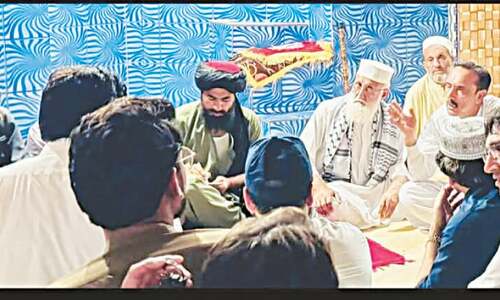
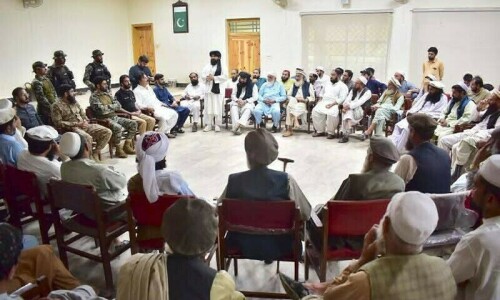
Occasionally, the security forces convene jirgas with local tribes and mobilise lashkars against militants, as was recently seen in Bajaur, where security officials sought to gain the tribesmen’s confidence regarding their CT operations. However, such engagements are infrequent and seldom integrated into a broader strategy. The dominant pattern remains one of evacuating areas and displacing local populations or conducting small- to medium-scale operations that restrict civilian movement, often without prior warning or any provision for livelihoods.
Within this framework, engagement with local communities lacks the consistency, trust-building and institutional backing necessary for a successful CT strategy. Without a deliberate reorientation towards long-term civilian support and political legitimacy, operational victories are unlikely to translate into sustainable peace.
The engagement initiative in Bajaur came only after the launch of a military offensive against militants, a sequence that undermined its effectiveness. In that operation, three civilians, including a 12-year-old boy and a young girl, were reportedly killed, and at least 12 others injured. Engagement should have come first. The local population should have been taken into confidence before deploying a heavy military contingent and imposing prolonged curfews.
Moreover, the provincial government was apparently not brought on board during this operation, further deepening mistrust among the population. The jirga in Bajaur should have been initiated by the provincial government rather than the security forces to lend greater political legitimacy and reduce the perception of unilateral action.
KP is one of Pakistan’s most critical provinces. It is grappling with severe governance challenges and widespread political discontent. The political outlook of the majority in KP often diverges from that of the power centres in Islamabad and Rawalpindi, fostering a sense of alienation and suspicion. Several districts in the province have become ungovernable due to persistent militancy. In such a context, nothing can replace the value of a consensus-based CT strategy, one that is locally rooted and politically inclusive.
The recent incident in Khyber district’s Tirah Valley mentioned earlier, illustrates the urgency of such an approach. In response, a local jirga not only demanded a formal inquiry into the killings but also called for the evacuation of civilian homes occupied by security forces within 15 days and an end to unnecessary harassment of citizens at checkpoints. These demands reflect deep-seated grievances and highlight the need for a more humane, transparent, and politically accountable approach to security operations.
Pakistan’s departure from the colonial-era counterinsurgency approach of rule by exception was shaped by a mix of military repression and divide-and-rule politics, rooted in imperial anxieties over borders, tribal autonomy and anti-colonial resistance.
The Frontier Crimes Regulation, based on collective action, was the worst legal framework, which Pakistan abandoned after seven decades. But there is still a mindset that wants to run the affairs of the tribal districts within the same framework. If someone is thinking of bringing back these laws and restoring Fata’s status, it would be a grave mistake, which can trigger anger and mistrust.
The British co-opted the maliks and used jirgas to manage conflict and secure cooperation. Tribal lashkars were at times mobilised to act on behalf of the state. However, these colonial-era approaches can be counterproductive today. Past military operations in the tribal districts have significantly transformed the region’s social structures. The forced displacement of local populations not only traumatised communities but also exposed many to urban life and alternative social models. As a result, a new middle class is emerging in these districts, one that does not identify with colonial methods of control. While a few traditional elders and religious parties, who once benefited from draconian colonial laws, may still support such approaches, they no longer represent the broader aspirations of the population.
As echoed by David Galula and reaffirmed in modern counterinsurgency doctrines, a lasting solution to insurgency lies not in overwhelming military force but in political strategy. Counterinsurgency is 80 per cent political and only 20pc military. It demands serious attention to the underlying grievances that fuel unrest, corruption, exclusion, inadequate service delivery and ethnic or sectarian marginalisation.
Military force must be applied with precision and restraint, avoiding harm to civilians, which only deepens alienation. Insurgencies are long and complex wars; tactical victories mean little without strategic consistency and political legitimacy. The most effective strategies are those that are adaptive, locally grounded and responsive to evolving realities on the ground. The wisdom distilled from decades of conflict is simple yet profound — we can’t kill our way out of an insurgency.
The writer is a security analyst.
Published in Dawn, August 3rd, 2025