The agriculture sector finds no respite — its challenges continue to mount. Climate change has altered the monsoon rainfall pattern. Intense downpours lasting only a few hours have replaced the light spells that typically stretched over several days in the past.
Sheikhupura (Punjab) experienced a one-day downpour of 217 mm (nine inches) recently on July 16, 2025. Likewise, on August 1, 2024, Lahore was lashed by a record-breaking rainfall of 337 millimetres (13 inches) in just a few hours. To top it all, the number of days with rainfall above 100 mm has significantly risen.
As a direct consequence of this new pattern, the recent heavy rains have left vast areas of cultivated land submerged for days in several districts of Punjab as natural waterways failed to carry the rainwater away. In the past, the issue of standing water was observed in several districts of Sindh and southern Punjab, particularly following the devastating floods of 2010 and 2022, as well as after episodes of heavy rainfall in certain years.
However, this time, the phenomenon is unfolding — perhaps for the first time and quite unexpectedly — in multiple districts of central Punjab. The standing water has devastated crops, particularly those that are very sensitive to waterlogged conditions, such as sesame and cotton. This loss has further worsened the plight of farmers, who are already challenged by fragile farm economics due to soaring input costs, declining crop yields, and falling market prices.
The added risk of waterlogging after rains has compounded climate change vulnerabilities for farmers
The recent rains have laid bare serious flaws in Punjab’s agricultural drainage systems. Unplanned construction, poorly designed rural road networks, illegal encroachments on waterways, and neglected maintenance and desilting of drains have severely disrupted natural rainwater flow.
As a result, waterlogged conditions are now evident not only in low-lying areas but also in well-levelled fields that are typically well-drained. One thing is certain: it is highly unlikely that the government will be able to restore the natural flow of rainwater by reversing the damage done to the natural topography.
On the other hand, farmers are not entirely without blame. Many have allowed housing societies, private builders, and road contractors to excavate their fields to obtain fill material. Similarly, thousands of brick kilns operating across Punjab source clay — their primary raw material —from agricultural land.
In most cases, farmers aim to lower their fields (reducing the surface elevation of their land) primarily to gain convenience and efficiency in our gravity-fed irrigation system.
Unplanned construction, poorly designed rural road networks, illegal encroachments on waterways, and neglected maintenance and desilting of drains have severely disrupted natural rainwater flow
In the process, however, many have excessively lowered their land, leaving it vulnerable to waterlogging during intense downpours. In the given situation, the only viable path forward is to address the issue through localised, site-specific solutions.
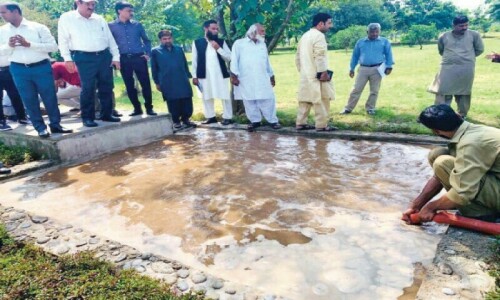
Government authorities have long been aware of the growing challenge of standing water, which has steadily intensified over the years. The Punjab Agriculture Department implemented a pilot project from 2016 to 2018, with a financial allocation of Rs61 million, facilitating farms in seven cotton-growing districts of south Punjab, where natural water drainage systems were ineffective. Under a cost-sharing arrangement with farmers, the primary intervention focused on constructing ponds to collect excess rainwater and providing portable water pumps for its subsequent reuse in irrigation.
While pond construction remains a workable solution for managing standing water, groundwater recharge wells, which replenish the subsurface aquifer, have recently emerged as a promising alternative. Such wells are not only cost-effective but also promote more efficient land use. Moreover, they help tackle another critical challenge facing Punjab’s agriculture sector: the rapidly depleting groundwater caused by excessive tubewell pumping.
Unfortunately, awareness among farmers and other stakeholders about recharge wells and their technology remains extremely limited — almost negligible. Similarly, service providers for this technology are virtually non-existent. Therefore, the government’s foremost responsibility is to raise awareness among farmers and actively promote the adoption of recharge wells at the farm level.
This should be done in collaboration with the private sector through well-designed projects centred on cost-sharing arrangements with farmers. The government’s initiatives will help establish a market for service providers — much like the Punjab government previously did with the promotion of precast concrete parabolic lining technology for watercourses.
Yet, the government’s response to this mounting challenge remains conspicuously absent. Policymakers have failed to recognise that climate change — manifesting through erratic rains, rising temperatures, and intensifying heatwaves — is already posing an existential threat to Pakistan’s agriculture. Crop after crop is falling victim to climate-induced stress. Now, the added risk of waterlogging after rains has further compounded their vulnerability.
One wonders what more must happen before it triggers a serious policy response and meaningful programmatic intervention from our policymakers, who remain largely reactive instead of proactive. While significant funds continue to flow into the agricultural sector, a large chunk is spent on populist initiatives rather than addressing the sector’s core structural challenges. Without a shift in approach, sustainable agricultural growth in the country will remain an elusive goal.
Chaudhary Mohammad Ashraff is the former Director General (On-Farm Water Management) of the Punjab Agriculture Department. Khalid Wattoo is a development professional and a farmer.
Published in Dawn, The Business and Finance Weekly, August 11th, 2025