Experts urge advocacy for HPV vaccine uptake after Sindh govt rollout

National health stakeholders on Tuesday called for greater advocacy and public awareness to ensure the success of Sindh’s upcoming human papillomavirus (HPV) vaccination campaign.
The HPV vaccine protects against genital warts and most cases of cervical cancer. Estimates indicate that every year in Pakistan, 5,008 women are diagnosed with cervical cancer and 3,197 die from the disease. It is also the third most common cancer in women nationwide and the second among those aged 15 to 44.
The Sindh government recently announced it would launch an HPV vaccination campaign in September for schoolgirls aged nine to 14. Studies and clinical trials consistently showed that HPV vaccines were extremely effective at reducing infections with the types of the virus that can lead to cancer, as well as cervical precancers.
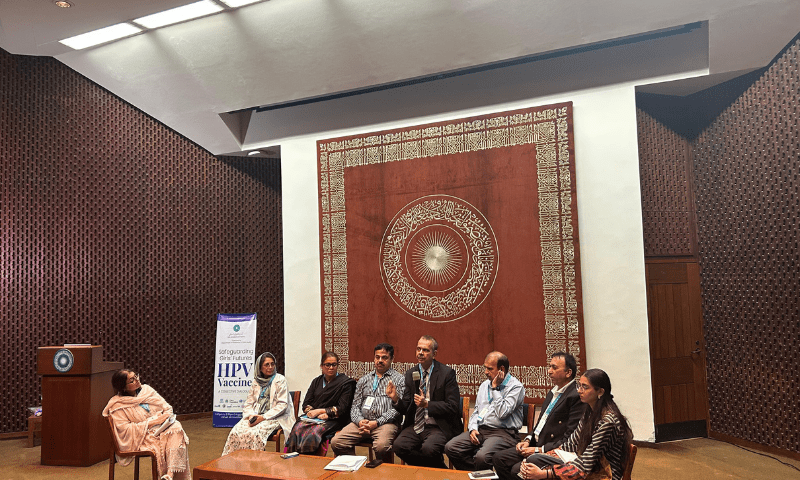
An event titled ‘Safeguarding Girls’ Futures’ was organised by Aga Khan University’s Department of Paediatrics and Child Health today, aiming to raise awareness about HPV, share global evidence on the vaccine and address cultural, religious and gender-related concerns.
The event was attended both in person and virtually by public health experts, representatives of non-governmental organisations and government officials, including Dr Muslima Ejaz, Dr Fyezah Jehan, Professor Karim F. Damji, Sindh Health Secretary Rehan Iqbal Baloch, Dr Quamrun Nahar, Dr Paul Bloem, Dr Afshan Issani, among others.
“Science is offering us the chance to prevent cervical cancer before it begins,” Dr Ejaz told the audience.
“Globally, cervical cancer claims over 300,000 women’s lives each year, with the greatest toll in low and middle-income countries. In Pakistan, it remains the leading cancer in women, often diagnosed far too late. But today, we are not here to speak only of disease. We are here to speak about prevention.”
Dr Jehan pointed out that the rates of infection from HPV depended on factors such as age, gender, sexual behaviour and geography. “There are more than 200 types [of HPV] which are known to us, and these are mostly classified for risk purposes into low-risk and high-risk types,” she added.
“Infections in the low-risk [type] are mostly asymptomatic and self-resolving,” Dr Jehan stated. “However, HPV 16 and 18 — the virus strains of particular interest — are among 14 high-risk HPV types responsible for 70-80 per cent of all cervical cancer cases. These deaths are entirely preventable, but only if we act early.”
Addressing the audience, the Sindh health secretary said, “The target [of the vaccine campaign] is around four million, out of which 50pc are in school and 50pc are out of school. Mostly the focus would be on girls aged nine to 14 years.”
He added that Gavi, a public-private global health partnership working to expand vaccine access in lower-income countries, was providing support. However, he stressed the need for greater advocacy from parents, teachers, paediatricians and gynaecologists.
Among all obstacles in the vaccine rollout, Dr Jehan said the cost and supply of the HPV vaccine were not an issue, as global donor agencies, particularly Gavi, in partnership with the government, had ensured the necessary doses were available free of charge through the Expanded Programme on Immunisation.
“This is a vaccine that people used to pay Rs7,000 for; now it is completely free and easily accessible,” she told Dawn.com.
She stressed, however, that public perception could pose a barrier and there was a need for greater awareness to ensure uptake. Dr Jehan added that reaching the 2m out-of-school girls will be a major challenge, despite planned efforts.
While most people are familiar with conventional preventive vaccines that boost the body’s natural defences against foreign invaders, currently only two approved vaccines can reduce the risk of cancer by protecting against viral infections that cause the disease.
These are the hepatitis B vaccine and the HPV vaccine. As Dr Issani pointed out, “There are very few strategies that can be used to prevent cancer, and the cervical cancer vaccine is one of them.”
Last month, the District Health Authority in Chiniot planned to immunise a total of 111,101 girls aged between nine to 14 for HPV.
In March, health experts at a seminar in Peshawar also advised women to undergo regular checkups for cervical cancer screening to prevent complications.