Potential to prosperity


EVERY $1 invested in nutrition yields $23 in economic returns according to global studies. This is particularly true when that investment happens early, from conception to two years of age, when the brain and body grow at their fastest, requiring adequate amounts of essential nutrients.
The returns are real: they are seen in children who grow and develop well, stay healthier, remain in school longer and grow into productive adults. Good nutrition reduces healthcare costs, strengthens communities, and drives national progress.
But the reverse is equally true — when this investment is missed, the costs are devastating, with inaction projected to cost $41 trillion globally over the next 10 years. Malnutrition robs children of their potential and nations of their future. It weakens bodies and impairs cognitive development, locking families into cycles of poverty that can last for generations.
The world is off track to end malnutrition — a crisis that contributes to nearly half of all deaths among children under five and one in five maternal deaths.
In Pakistan today, nearly 40 per cent, and in the poorest quintile 50pc, of children are stunted. Stunting means a child is too short for their age, signalling prolonged inadequate nutrition, which affects not only growth in length, but also short- and long-term health and development, and is largely irreversible.
Nutrition is Pakistan’s best investment.
These risks are compounded in times of crisis. The recent flash floods in Pakistan illustrate how quickly climate shocks can undo progress: crops destroyed, livelihoods lost and families displaced. In such emergencies, women and children face the greatest burden — with disrupted access to food, healthcare and safe water, the dangers of malnutrition intensify.
Targeted interventions during pregnancy and early childhood are critical, particularly for the poorest households. Across Pakistan’s provinces, 73-87pc of all households cannot afford a diverse, nutritious diet, with cost being 1.5 to 1.7 times higher than households’ current food expenditure (Pakistan Bureau of Statistics, 2024). This results in large dietary gaps, even larger among the poorest households, leaving much of their food and nutritional needs unmet.
Global evidence shows that the most effective nutrition programmes combine specialised nutritious foods, access to maternal and child health services, social and behaviour change, communication to promote breastfeeding and complementary feeding, to improve diets within the families’ means.
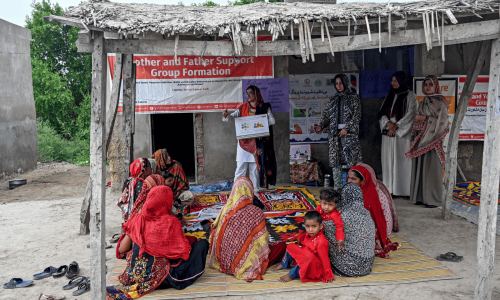
Pakistan’s Benazir Nashonuma Programme stands as an evidence-based global example of these best practices. Implemented under the Benazir Income Support Programme, Nashonuma combines conditional cash transfers, integrated health services, nutrition counselling, and specialised nutritious foods for pregnant and breastfeeding women and children under two.
The specialised nutritious food provided — Maamta for mothers and Wawamum for children — consists of 50-75 grams of nutrient-packed paste made from chickpeas and other ingredients such as vegetable oil, skimmed milk powder and vitamin and mineral premix, designed to fill critical nutrient gaps during pregnancy, breastfeeding and early childhood.
In many low-income households, diets are repetitive, often consisting of foods of just one to three of eight food groups, dominated by cereals, and lacking nutrient-rich foods such as eggs, milk, fish, fruit and vegetables.
The specialised food does not replace daily meals, it fills critical nutrient gaps that current diets of this target group cannot address, especially during pregnancy and early childhood. For long-term impact, it must remain part of the comprehensive pac-kage while efforts to improve dietary diversity continue.
The model is showing promising results according to preliminary results of an independent impact evaluation. While no single approach can solve the nutrition crisis alone, such evidence underscores that when interventions are comprehensive, targeted and delivered at scale, they can move the needle quickly.
For Pakistan, investing in early life nutrition, especially during the first 1,000 days, is a smart economic strategy, and as the country responds to ongoing floods, protecting early life nutrition must remain a priority. This aligns with Pakistan’s commitments under the Sustainable Development Goals and the Scaling Up Nutrition Movement.
The country already knows what works. The task now is to sustain and strengthen proven approaches, ensure they reach the most vulnerable households, and safeguard the core elements that make them effective, including targeted nutrition support.
Dr Saskia de Pee is WFP’s senior adviser on Analytics & Science for Food & Nutrition. Nazeer Ahmed is chief, Nutrition Section, Ministry of Planning, Development & Special Initiatives.
Published in Dawn, September 10th, 2025