COMPARED to the coldness of the Biden administration towards Pakistan, bilateral relations under Donald Trump’s watch have warmed up considerably.
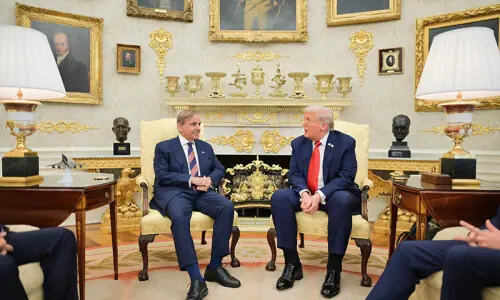
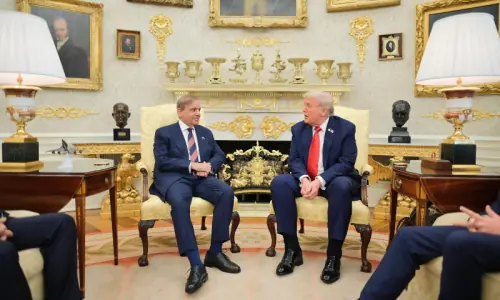
Early on Friday, the prime minister and the army chief met the American leader in the White House to mainly discuss, as a PM House readout describes, security, counterterrorism and investment issues. Mr Trump had earlier in the week met Shehbaz Sharif in New York, during a meeting with leaders of Muslim states on the sidelines of the UNGA to discuss the Gaza war. In June, the army chief had an unprecedented lunch with the American president. This is the first time a Pakistani prime minister has had a dedicated bilateral interaction with a US president in six years; the last interaction was between Imran Khan and Mr Trump in 2019.
Apart from the photos of beaming leaders and mutual appreciation — Mr Trump referred to Mr Sharif as a “great leader”, while the PM called the US leader “courageous” — the details of what was discussed are sketchy. As per the Pakistani side, tensions in the Middle East and South Asia, along with investment opportunities in Pakistan, were mentioned. The PM lauded Mr Trump’s efforts to end the war in Gaza, calling him a “man of peace”.
The US leader may be many things, but a peacemaker he is not, having attacked Iran in June, while if he really wanted to end the Gaza genocide, he could halt all American weapons and funds transfers to the Israeli regime. It is, therefore, hoped that behind closed doors, Mr Sharif convinced the president of the need to immediately end the Gaza slaughter, as well as finding a just solution to the Kashmir dispute.
Should this be seen as a great reset in Pakistan-US ties, or simply a temporary phase of positivity? Historically, the relationship has been a transactional one, with the US supporting Pakistan and providing it arms and aid at key junctures — the Cold War, the Afghan Jihad, the ‘war on terror’ — only to turn ambivalent, or even hostile, once its geopolitical aims were achieved.
The Biden era was a clear example of American indifference towards Pakistan. Moreover, the incumbent US president is known to change positions overnight, so to formulate future policy on the basis of a few interactions would be unwise. Besides, the foreign policy priorities of Islamabad and Washington diverge considerably in several areas, including the Palestine question, ties with Iran and the relationship with China.
Can Pakistan balance relations with the US while maintaining its principled stand on these issues, particularly its ties with China? The lesson of history is that while better ties with the US should be pursued, Pakistan should be prepared for abrupt changes in American policy.
Published in Dawn, September 27th, 2025