PAKISTAN stands at the front lines of the global climate crisis. From heatwaves and droughts to devastating floods that threaten lives and livelihoods each year, the economic and human toll of climate change is rapidly escalating. According to initial estimates from the brokerage house Arif Habib Ltd, the economic cost of the 2025 floods on the agriculture sector exceeds Rs302 billion.
Agricultural insurance can play a pivotal role in mitigating risks for farmers in Pakistan, enabling them to recover from losses and sustain their livelihoods. However, traditional insurance mechanisms in Pakistan have struggled to meet this need. Agricultural insurance coverage remains extremely low, with only 9.5 per cent of farmers in the country insured as of 2023.
Studies indicate multiple barriers: products are often poorly tailored to the needs of smallholder farmers, premiums remain unaffordable for many, and claim processes can be cumbersome. Religious concerns around interest-based products discourage many Muslim farmers from purchasing conventional insurance, while low awareness of Islamic (takaful) insurance products limits uptake. Together, these factors have rendered insurance products too limited and inaccessible for most rural households, underscoring the need for innovative solutions, such as parametric insurance.
Parametric insurance is a financial risk transfer tool that provides payouts based on the occurrence of a pre-defined event, rather than the assessment of actual losses. Instead of sending inspectors to measure damage, payouts are automatically triggered when certain measurable conditions are met. The automatic payouts can be linked to climate thresholds, such as rainfall falling below a critical level, extreme heat persisting for multiple days, or floodwaters exceeding a set depth.
This model differs from traditional insurance in both speed and simplicity. Because payouts are based on objective data, disbursements can occur within days, helping disaster-affected communities recover faster. The approach has already proven successful in countries such as Malawi, Indonesia, and Fiji, where farmers and low-income households have used parametric insurance to protect against storms and drought. These experiences demonstrate how parametric insurance can complement existing disaster management systems while reducing uncertainty for both the insurers and beneficiaries.
When a climate event occurs, those most financially insecure bear the brunt of the cost of the damage and repair, as they cannot wait for national or international aid to support their basic housing and nutritional needs. Each major disaster brings a cycle of emergency relief, donor dependence, and fiscal strain while people remain trapped in a vicious debt cycle.
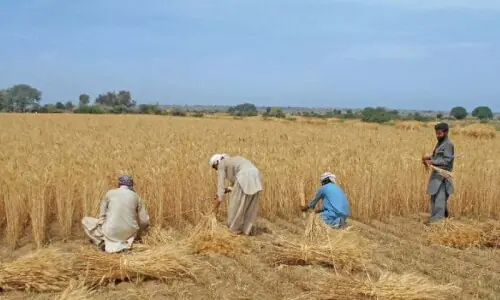
Agricultural insurance can play a pivotal role in mitigating risks for farmers in Pakistan.
By linking payouts directly to climate indicators, parametric insurance ensures early disbursement, reduces bureaucratic delays, and enhances transparency. Households benefit from timely access to funds for recovery. The government benefits from reduced post-disaster expenditure and greater budget stability.
Parametric insurance can be easily integrated into existing social protection and financial platforms such as the Benazir Income Support Programme, microfinance products, and agriculture loan programmes. When financial institutions embed parametric insurance into their loan products, it serves as an income protection tool, enabling clients to continue obligations, avoid default, and stabilise their livelihoods.
Parametric insurance is a resilience-building tool that enables communities to prepare for and recover from disasters more effectively. Quick and transparent payouts prevent negative coping strategies such as selling assets or taking high-interest loans. By reaching underserved groups, parametric products can also advance financial inclusion, offering protection to smallholder farmers, women, and low-income households that are excluded from conventional insurance systems. On a macro level, it helps reduce fiscal pressure on the government by transferring part of the disaster risk to insurers.
Moreover, parametric instruments can attract donor and private investment, aligning Pakistan’s risk financing with global climate adaptation goals. Integrated within the country’s National Adaptation Plan and Sustainable Development Goals commitments, such tools can help the country transition from reactive disaster relief to proactive resilience planning.
However, designing effective parametric insurance schemes requires addressing several structural challenges. Accurate and reliable high-resolution climate data is essential for setting appropriate thresholds and avoiding ‘basis risk’ (when payouts do not match the actual losses) but Pakistan’s weather monitoring infrastructure remains sparse, especially in the rural regions.
Lack of awareness and trust can also impede the uptake of novel insurance instruments as many potential users are unfamiliar with the concept of insurance or may have religious objections, with many Muslims viewing conventional insurance as ‘forbidden’ due to its involvement with interest and excessive uncertainty as prohibited by religious law. Affordability poses another challenge, particularly for small-scale farmers. Finally, the regulatory framework must evolve to accommodate index-based products while ensuring consumer protection and transparency. Without institutional and regulatory readiness, scaling up parametric insurance will remain difficult despite its strong potential. A supportive policy environment is therefore critical for parametric insurance to take root.
Pilot projects that combine public, private, and donor financing can help test parametric insurance models in climate-prone areas and build local capacity for uptake. With the right data, institutional support, and community engagement, parametric insurance can become a game-changer, enabling Pakistan to move from reactive crisis management to proactive, climate-smart resilience planning.
Maha Qasim is an environmental and sustainability expert. Dania Nasir is a sustainability professional.
Published in Dawn, October 22nd, 2025