IHC judge recuses from hearing case challenging Justice Jahangiri’s eligibility
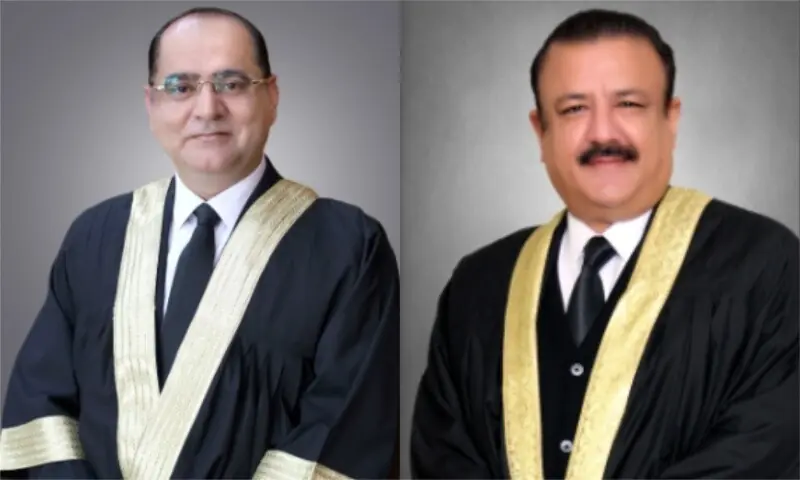

Islamabad High Court’s (IHC) Justice Khadim Hussain Soomro on Tuesday recused himself from hearing the case challenging the eligibility of Justice Tariq Mehmood Jahangiri.
A complaint pertaining to Justice Jahangiri’s allegedly fake law degree was submitted to the Supreme Judicial Council last year in July, while a petition challenging his appointment was filed in the IHC last year. The matter centres on a letter that began circulating last year on social media, purportedly from the University of Karachi’s (KU) controller of examinations, regarding the judge’s degree.
Today, a two-member bench, comprising Chief Justice Sarfraz Dogar and Justice Soomro, took up a miscellaneous application filed by the Islamabad Bar Association (IBA) seeking to become a party in the matter.
During the proceedings, Justice Soomro recused himself from hearing the case, following which the bench stood dissolved, and the hearing was adjourned without any further proceedings.
His decision comes after a division bench hearing a writ petition filed by Advocate Mian Dawood, which questioned the legitimacy of Justice Jahangiri’s LLB degree, was reconstituted. Justice Mohammad Azam Khan was previously part of the bench led by Justice Dogar.
It may be recalled that Justice Jahangiri is one of the five judges who challenged the transfer of Justice Dogar, as well as of two other judges — Justice Khadim Hussain Soomro and Justice Mohammad Asif — to the IHC.
In its application, the IBA argued that fair and transparent adjudication of the pending writ petition would be impossible without hearing the bar as a party, since the issues involved are of “fundamental importance” to the legal fraternity and the rule of law.
The lawyers’ body emphasised that under its Memorandum of Association (2016), it is mandated to safeguard the rule of law, the independence of the judiciary, and civil liberties. It further maintained that the bar has historically been at the forefront of struggles for constitutional supremacy and must therefore be heard in this matter.
The plea recalled that the bar’s functions include facilitating its members in the performance of their professional duties, protecting their interests, and maintaining high standards of integrity and ethical conduct.
“The Islamabad Bar is resolute in shielding the superior judiciary from attacks, whether internal or external, and in striving for the supremacy of the Constitution,” the application stated.
Case developments
On September 16, a division bench comprising Justices Dogar passed an interim order restraining Justice Jahangiri from performing his judicial functions.
The judge then filed an appeal against the decision before the Supreme Court in person. Subsequently, the restraining order, issued without notice to the respondent, was suspended by a five-member Constitutional Bench of the SC on September 29.
The next day, the bench set aside the IHC ruling, declaring it “null and void”. The bench led by Justice Aminuddin Khan observed that no sitting judge could be barred from performing judicial duties through an interim order of a high court.
Four days earlier, the Sindh High Court (SHC) extended its earlier interim order suspending the KU syndicate’s decision to cancel Justice Jahangiri’s law degree.
A two-judge bench of the SHC headed by Justice Muhammad Iqbal Kalhoro stated that the interim order would continue till November 27 after federal and provincial law officers again sought more time to file comments.
Advocate Mian Dawood’s petition against Justice Jahangiri, filed under Article 199 of the Constitution, seeks a writ of quo warranto (by what authority) against him — a jurisdiction rarely invoked in such circumstances.
It argues that his foundational qualification for judicial office — an LLB degree from KU — is “invalid”, thereby rendering his entire legal career and subsequent appointment illegitimate.
The key allegations in the petition include the use of dual enrollment numbers, as the record shows two different enrollment numbers for Justice Jahangiri’s LLB Part-I and Part-II examinations. The KU has previously stated that it is “impossible to allot two enrollment numbers to a student for one programme”.
The petition argued that the appointment of a judge without the requisite legal qualification is not just an administrative error, but a violation of the fundamental rights of all citizens.
Days before the controversy over his degree initially surfaced, Justice Jahangiri was expeditiously hearing election petitions against alleged rigging in all three constituencies of Islamabad.