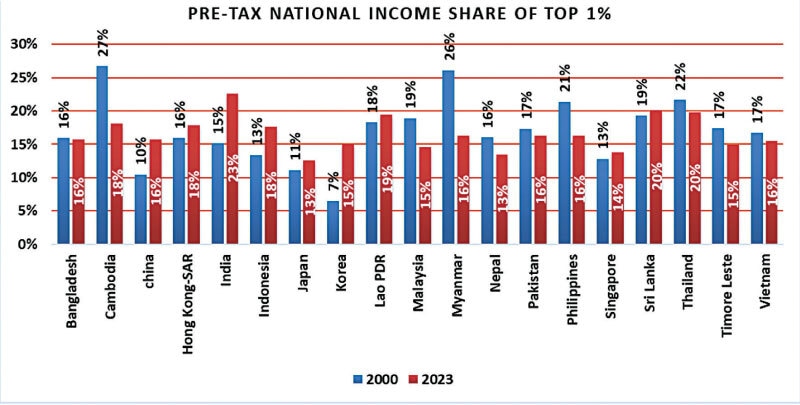
IN PAKISTAN, the wealthiest 10 per cent hold 42pc of the national income — lower than the average across major Asian economies, but still enough to create massive inequalities that make it impossible to build fair or sustainable societies.
This is one of the findings of an Oxfam report, highlighting uneven patterns of economic growth driven by widening wealth disparity, climate change and the digital divide.
Titled An Unequal Future: Asia’s Struggle for Justice in a Warming, Wired World, the report makes for grim reading: the richest 10pc capture 60-77pc of national income, while the poorest 50pc receive only 12-15pc; and the top 1pc own nearly half the wealth.
The report points out that in the past decade, the fortunes of Asian billionaires have more than doubled, whereas the poorest half of the population in countries like China, India, Indonesia, and Korea, saw their share of income decline.
Oxfam report sees elite capture of wealth & income, climate crisis and digital divide as major challenges facing Asian nations
“The income share of the poorest 50pc has declined in almost all countries except Bangladesh, Cambodia, Malaysia, Myanmar, Nepal, Pakistan, the Philippines, Sri Lanka, Thailand, Timor-Leste and Vietnam. The increase in these countries is also minimal, around 1pc, except in Cambodia, Malaysia, Myanmar, the Philippines and Timor-Leste,” the report notes.
Dr Abid Aman Burki, who teaches poverty and inequality at Lahore University of Management Sciences, sees the report as a “bold attempt” at highlighting income and wealth disparities in the region.
“I think there is relevance for Pakistan,” notes Amitabh Behar, Executive Director at Oxfam International.
“Pakistan is among the countries in Asia hardest hit by floods and climate shocks, yet the richest continue to hoard wealth and dodge taxes, leaving ordinary people to face the worst of the destruction,” he told Dawn.
For the widening inequality in Pakistan, Dr Burki blames the current economic model. “It benefits the powerful elite with a tax system reliant on indirect taxes while disproportionately burdening low- and middle-income households.”
With public spending skewed towards debt repayment, defence, and subsidies for the elite, “there is very little left for health, education, and social protection” he added.
This assertion seems to be backed by Oxfam’s research: “In 2022, public investment in education amounted to 8pc of GDP in Bhutan and Kyrgyzstan, but less than 2pc of GDP in Papua New Guinea, Pakistan, Cambodia, Laos and Sri Lanka,” the report states.
The report also details how indirect taxation disproportionately affects lower-income households. “In 2022, the tax-to-GDP ratio was at or above 30pc in Japan, Korea and New Zealand, compared to around 10pc in Laos and Pakistan.”
While countries such as New Zealand, Australia, Korea and Japan have moderate value-added taxes and strong social spending capacities, countries with high direct taxes, including Afghanistan, Bangladesh, Bhutan, Malaysia, Indonesia, Pakistan, the Philippines, Thailand and Vietnam, show continued reliance on indirect taxes. Hence, the burden still falls disproportionately on poorer households, it noted.
Climate, digital divide
However, economic reforms alone cannot close the widening gap between rich and poor; the climate crisis and the digital divide must also be addressed, as both deepen inequalities across the region, the report observes.
Nowhere is this more visible than in Asia, which the World Meterological Organisation terms the most “disaster-hit region”, recording over 1,800 events in the last decade, which claimed over 150,000 lives and affected over 1.2 billion.
Five of the world’s most vulnerable nations — Bangladesh, Nepal, Myanmar, Pakistan and Sri Lanka — home to over 500 million people, bear the heaviest burden due to climate disasters.
To tackle and adapt to disasters, Asia requires around $1.11 trillion annually, but receives only $333bn, but much of this comes in the form of loans, the report notes ahead of the November COP30. “Wealthier nations continue to shirk their responsibility to pay for the climate damage they have caused in countries like Pakistan,” said Behar.
The report also emphasises the need to bridge the digital divide, which is largely defined by geography, affordability and social status. In the Asia-Pacific, 83pc of the urban population has access to the internet, compared to just 49pc in the rural areas.
“Across Asia, women, especially in South Asia, remain far less connected than men. Out of 885 million women in low- and middle-income countries not using mobile internet, 330 million live in South Asia,” the report states.
Pointing out the barriers such as affordability, low digital literacy, safety concerns, and unpaid care work, the report said these limit women’s access and exclude them from digital and tech-driven jobs.
Published in Dawn, October 30th, 2025