District Vulnerability Index launched
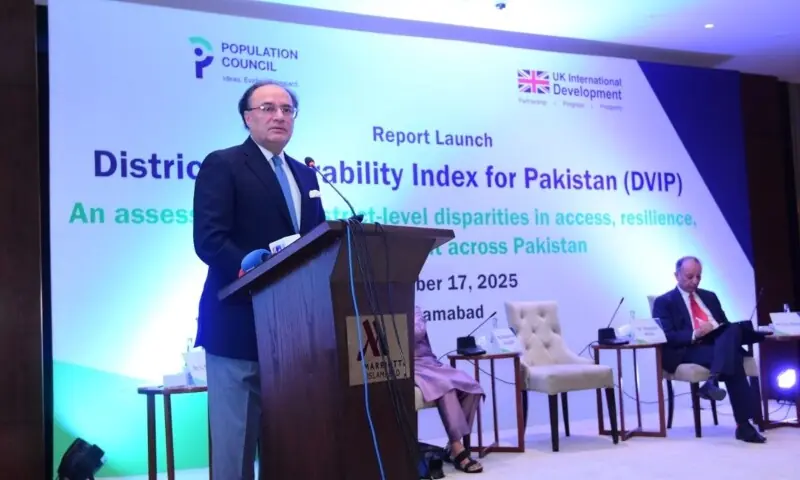

ISLAMABAD: Minister for Finance Muhammad Aurangzeb has said the country’s long-term economic prospects depend on effectively confronting the dual national challenges of rapid population growth and climate vulnerability.
He made the observation while addressing the launching ceremony of the District Vulnerability Index for Pakistan (DVIP), organised by the Population Council in collaboration with the Foreign and Commonwealth Development Office (FCDO).
The finance minister said the impacts of high population growth are visible in persistent human development challenges, including child stunting, learning poverty and a workforce insufficiently equipped for the future.
He commended the Population Council for producing a comprehensive, data-driven District Vulnerability Index based on three years of research. He emphasised that the index provides actionable management information through its detailed analysis across six domains, offering meaningful insights into geographic disparities and identifying districts most at risk, particularly in Balochistan and Sindh.
Aurangzeb calls for addressing rapid population growth and climate vulnerability
The findings illustrate how social vulnerabilities and climate exposure reinforce each other, creating compounded risks for already marginalised populations.
The finance minister affirmed his ministry’s commitment to supporting national efforts in population and climate-related policymaking by integrating these priorities into budgeting and resource allocation.
Addressing the gathering, Minister for Climate Change Dr Musadik Masood Malik highlighted the human dimension of the DVIP’s findings. He stressed the need to reduce regional disparities by increasing resource allocation to vulnerable districts, following principles of equity.
Discussing the reasons for persistent structural vulnerability, he recommended revising the NFC Award formula, which currently rewards large populations. Instead, he proposed alternative criteria that encourage social sector advancement and poverty reduction.
Introducing the DVIP, Population Council’s Country Director Dr Zeba Sathar said: “The District Vulnerability Index offers a powerful lens into the multifaceted nature of vulnerability across Pakistan. By pinpointing where and how people are most at risk, it provides essential guidance for directing public resources, reducing disparities, and building resilience against future shocks.”
Sam Waldock, Development Director at the FCDO, reminded the gathering that socio-economic vulnerability in Pakistan is not insurmountable and can be overcome if effectively prioritised.
Published in Dawn, November 19th, 2025