Ex-officer tells inquiry UK military committed ‘war crimes’ in Afghanistan


LONDON: A former senior British officer has told a public inquiry that British special forces in Afghanistan appeared to commit war crimes by executing suspects, and despite widespread knowledge in the chain of command, nothing was done.
Britain’s defence ministry (MoD) ordered the inquiry after a BBC TV documentary reported that soldiers from the elite Special Air Service (SAS) had killed 54 people during the war in Afghanistan more than a decade ago in suspicious circumstances.
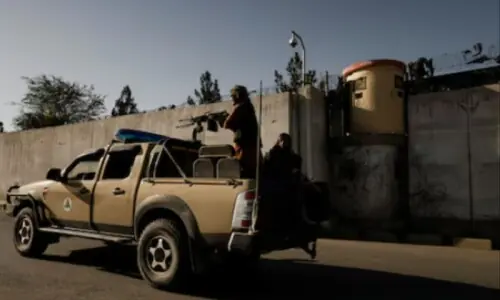
The investigation is examining a number of night-time raids by British forces from mid-2010 to mid-2013 when they were part of a US-led coalition fighting the Taliban and other militants.
Concerns from soldier
British military police have previously conducted several inquiries into allegations of misconduct by forces in Afghanistan, including those made against the SAS, but the MoD has said none had found enough evidence for prosecutions.
The inquiry aims to ascertain whether there was credible information of extra-judicial killings, whether investigations by the military police years later into concerns were properly conducted, and if unlawful killings were covered up.
Its chair, senior judge Charles Haddon-Cave, said it was important that anyone who broke the law was referred to relevant authorities while the cloud of suspicion was lifted from those who had done nothing wrong.
His inquiry has heard previously concerns from British soldiers who were in Afghanistan about a sub-unit referred to as UKSF1, with one saying they were killing fighting-age males during operations regardless of the threat they posed.
In new evidence, given in private but released on Monday, an officer known as N1466, who at the time was the Assistant Chief of Staff for Operations in the UK Special Forces Headquarters, revealed how, in 2011, he had grown suspicious of the number of detainees killed during UKSF1 activities.
Based on an examination of official reports following raids, he said the number of enemies killed in action (EKIA) exceeded the number of weapons recovered, and that reports of detainees repeatedly attempting to pick up weapons or use grenades after capture did not appear credible.
‘Talking about war crimes’
“I will be clear we are talking about war crimes … we are talking about taking detainees back on target and executing them with a pretence, the pretence being that they conducted violence against the forces,” N1466 told Oliver Glasgow, the lead lawyer for the inquiry.
He said he had raised the issue with the Director of Special Forces, referred to as 1802, but rather than consider criminal action, he had instead only ordered a review of the operational tactic.
The former officer said he regretted that he did not approach the military police himself at the time, although he did later report his concerns in 2015.
“I was deeply troubled by what I strongly suspected was the unlawful killing of innocent people, including children,” he said in his witness statement. “I had come to the view that the issue of extra-judicial killings was not confined to a small number of soldiers of a single subunit of UKSF1 but was potentially more widespread, and was apparently known to many in UKSF.”
Other evidence provided to the inquiry by former officers and a defence ministry official said there had been frustrations among soldiers that those captured during intelligence-led operations were being released days later, as the Afghan judicial system could not cope. It also heard there was great rivalry between the two special forces units UKSFI and UKSF3, to which N1466 belonged.
“I am also conscious that some people out there will want to portray me as … me against the as if I have got some sort of axe to grind … I would just like to put across now that nothing, nothing is further from the truth,” N1466 told the inquiry.
”… we didn’t join the UKSF for this sort of behaviour, you know, toddlers to get shot in their beds or random killing. It’s not special, it’s not elite, it’s not what we stand for, and most of us, I don’t believe, would either wish to condone it or to cover it up.” The inquiry continues.
Published in Dawn, December 2nd, 2025