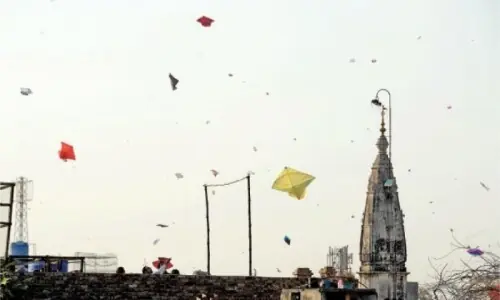

IT’S hard to shake off a feeling of ‘bread and circuses’ from the Punjab government’s recent ordinance to revive Basant in the province after an 18-year ban. As the political environment grows evermore stifled, as the space for dissent shrinks every single day, as the governing system becomes more centralised and opaque, and as critical voices (from Balochistan to Islamabad) confront lengthy incarcerations, mustering festive excitement seems to be a bit of a challenge.
But life goes on, as it usually does. Governments will do what they do for whatever ends. The people too deserve respite and joy in a society that provides little of either. And so there is a case to be made for the revival of a coming-of-spring festival that has deep cultural roots in this specific region.
My line of advocacy for the revival of the festival, on these very pages eight years ago, was fairly straightforward: Basant defines Lahore like few other activities. It was for the longest time the most eagerly anticipated event of the year. It drew in tourists, generated revenue for all kinds of associated businesses, and contributed to a general uplift in the public mood. It was also the only cultural event that transcended class boundaries in a city that otherwise segregates all manners of entertainment by the ability to pay.
It is that last part that needs to be underscored. Kite-flying is a relatively democratic activity. The monetary barriers to entry are generally low. Keeping aside competitive and commercial events, not much is required for an average person to participate. Kites and string are relatively inexpensive; roof space, while desirable and amply available, is not essential. People can and have in the past flown kites from large open spaces.
These appear to be prosaic points but they remain important given just how stratified leisure has become in a city like Lahore. Open green spaces are few and far between, and those that do exist are often actively policed in exclusionary manners. Old walled-city pastimes like pigeon racing and wrestling are inaccessible for the new urban poor, along with being highly gendered in their participation practices.
A public festival such as Basant remains an important corrective, even if it only lasts a weekend.
The universe of leisure in the city then remains confined to dining out, a practice that carries vastly different experiences contingent on your ability to pay. As the well-heeled recede to a plethora of privatised/faux public spaces, such as coffee shops, private member clubs, and restaurants, the popular classes have to make do with far more limited options.
In this unequal context, a public festival such as Basant remains an important corrective, even if it only lasts a weekend.
The bigger challenge, beyond the issuing of an ordinance, will be ensuring safety and preventing loss of life. As the point of origin of the ban recedes further into the past, it’s worth remembering why it was instituted in the first place.
Part of the story was the moral and cultural panic around the festival from conservative religious groups, who actively propagated against it on grounds of being a ‘Hindu’ festival. Leaving aside the fact that there is nothing wrong with the majority celebrating local cultural diversity, it is also worth noting that it is a geographically-specific festival, regardless of its religious affiliation. Like Lohri and Vaisakhi, it corresponds in large parts with the environmental and seasonal reality of a region; an ecological reality that one must stress does not change with the faith of its inhabitants. People of all religious persuasions still look forward to spring.
But this part of the story is less instrumental in the actual ban. In the early 2000s, the main drivers of public and political sentiment were the loss of life and damage to property (especially related to electricity distribution). In petitions filed in this time, including on behalf of those who had lost kin/relatives, numbers ranged from 30 to 40 deaths over a few years. In the one year that the festival was unbanned in 2007, 11 people were killed.
These deaths were related to dangerous, chemically/ materially enhanced string, as well as rooftop accidents, and incidents of electrocution. Motorcyclists (and those riding with them) were frequent victims.
Ultimately, then, the decision to revise Basant becomes a test of state capacity. The revised ordinance provides for powers to search and seize dangerous string, as well as prevent unregulated kite-flying activity. This means the local administration would have to devote considerable manpower and resources to regulate the sale and purchase of kite-flying equipment, provide clear guidelines of how and where activities can take place, and consistently monitor what people are actually doing in their own private spaces.
These are all difficult tasks, but perhaps in a twist of dark irony, the security calculus that prevails so much over the state’s functioning may enable it to carry out these tasks better than it was able to in the past. Additionally, the growth of CCTV monitoring, and the capacity and experience developed during the pandemic might be put to good use here as well.
There is one other point of concern in the legislation worth highlighting. The ordinance gives local administration the power to ban motorcycles from operating in any given territory. Presumably, this ban will be operationalised in various parts of the city on the day(s) of the festival. To me this seems like the most ham-fisted solution to the actual problem.
People on motorbikes are not the issue. Anyone going about their daily life (or on any urgent business) should not have to bear the brunt of regulatory failure. The real issue remains with the string and its associated dangers, as well as rooftop practices. That is where the state’s attention should remain confined, and where its capacity is best served.
The writer teaches politics and sociology at Lums.
X: @umairjav
Published in Dawn, December 8th, 2025