Call to empower the vulnerable on Human Rights Day

• President Zardari stresses need to strengthen legal, economic and social frameworks
• PM Shehbaz highlights how rights are not abstract ideals, but also include practical needs such as food, clean water and safety of life
• Global monitoring report reveals dearth of women in Pakistani media
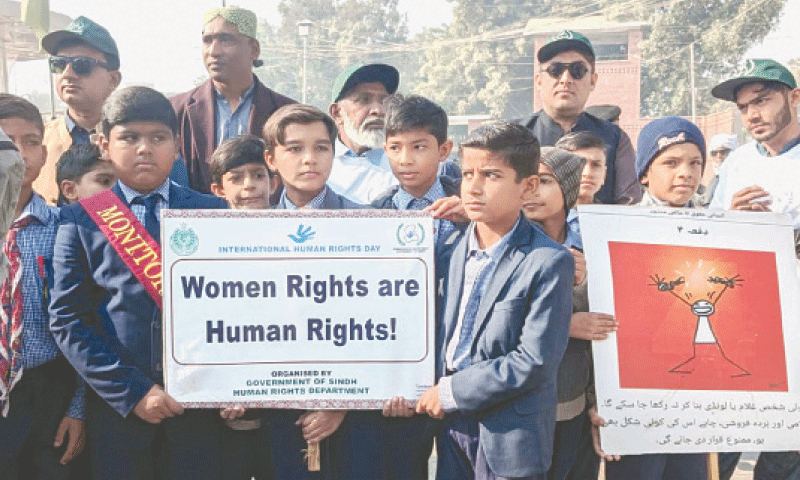
ISLAMABAD: As the world observes Human Rights Day today, Pakistan’s leaders have called on the nation to empower women, children, minorities and persons with disabilities to take full part in national life.
In their separate messages on the occasion – which commemorates the adoption of the Universal Declaration of Human Rights (UDHR) by the United Nations in 1948 – President Asif Ali Zardari and Prime Minister Shehbaz Sharif appealed to provincial governments, state institutions, political leaders, civil administration, media, civil society and especially the youth to play an active role in promoting tolerance, justice and human dignity, while stressing that the protection of human rights is a shared responsibility.
“We must work with civil society, human rights defenders, national institutions and international partners to uphold our shared values. Quaid-i-Azam Muhammad Ali Jinnah envisioned Pakistan as a country where people of every faith and background could live together in harmony and dignity. It is our collective duty to honour that vision and build a more inclusive society,” the president said.
President Zardari said the Constitution of Pakistan guarantees freedom to every citizen, without distinction of caste, creed or colour. The government remains committed to protecting and promoting human rights and will continue its efforts to safeguard the liberty, dignity and self-esteem of all citizens. We recognise the need to focus on vulnerable and marginalised groups and are working to strengthen the legal, economic and social frameworks needed to protect their rights, he said.
The prime minister stated that Pakistan remains committed to safeguarding fundamental human rights, especially the protection of human dignity and equal opportunities for all. He noted that Human Rights Day 2025 is being observed under the theme ‘Our Everyday Needs’, highlighting that human rights are not abstract ideals but practical necessities such as access to food, clean water and the safety of life.
Prime Minister Shehbaz Sharif highlighted ongoing governmental reforms aimed at strengthening state institutions to ensure social protection, gender equality, and the safeguarding of children, women, minorities, persons with disabilities and other vulnerable groups. He said Pakistan is striving to build a society where no citizen is left behind.
UN Secretary-General Antonio Guterres, in his message, stated that recent years have brought the shrinking of civil space. “We have grave violations that signal a flagrant disregard for rights, and a callous indifference to human suffering.” “Together, we have the power to confront these injustices by protecting the institutions that make human rights a lived reality. Our rights should never take second place to profit or power,” UN chief said.
Women representation in media
Meanwhile, findings from the Global Media Monitoring Project (GMMP) revealed that the number of women reporters working for Pakistani media had fallen from 16pc in 2020 to just four per cent in 2025, highlighting how progress on gender equality in the news has largely stalled in the country, as well as in 94 others.
A statement issued by the Uks Research Centre — which served as the national coordinator for this study in Pakistan — said the GMMP takes place once every five years and captures a snapshot of news content from one global monitoring day.
The day in question was May 6, 2025, when the global news agenda was dominated by India-Pakistan military tensions. The conflict shaped the media landscape that day and left very limited space for gender-related reporting. “No women reporters were recorded in television, radio, or internet news on May 6,” the statement said.
Regarding news on gender-based violence (GBV), the statement said that “across all media monitored on the monitoring day, only one story on GBV appeared,” adding “the sole story focused on intimate partner violence, portraying the woman strictly as a victim.”
“No human rights lens or legal framework was applied,” it noted.
Published in Dawn, December 10th, 2025