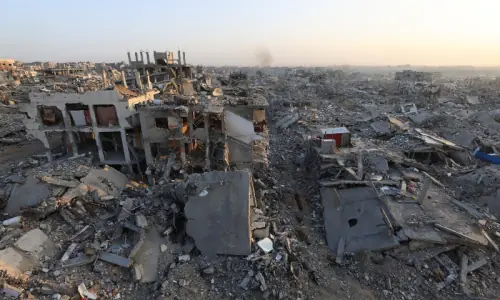
QUESTIONS are again being raised about Pakistan’s possible contribution to the so-called International Stabilisation Force in Gaza, after reports in the media suggested the US wanted this country to commit troops.
The Foreign Office has said that Pakistan has not been asked to send personnel, nor has the country taken a decision yet. The issue resurfaced after reports began circulating that Field Marshal Asim Munir was due to meet US President Donald Trump in Washington in the near future, with Gaza deployment to feature in the talks.
The FO contradicted these reports, while a White House official also said no such meeting was on the cards. Earlier, Foreign Minister Ishaq Dar had said that Pakistan could not take a decision until the ISF’s terms of reference were clear, adding that disarming Hamas was “not our job”.
Perhaps it is time that the state took a decision about the ISF deployment. Like most grand schemes of the Trump administration, the Gaza plan is high on hyperbole, and low on substance. Critically, the US State Department’s reported vision for foreign troops in Gaza to dismantle “terrorist infrastructure” and decommission weapons “used by terrorists” — euphemisms for disarming Hamas — is incredibly problematic, especially for Arab and Muslim states.
Mr Trump’s scheme seeks to put Muslim states on a collision course with Hamas and other resistance groups, and attempts to do what Israel failed. It is our view that no Muslim state should be fighting Palestinian groups, essentially doing Israel’s dirty work. It is perhaps because of this unsavoury aspect of the Gaza plan that so many states have refused to commit troops.
As per reports, Azerbaijan, Jordan, Egypt and other Arab states have all said that in the current conditions, they will be unable to send troops to the occupied Palestinian territory. Pakistan must not break with this consensus, and its own stated principles, by sending troops to confront Palestinian resistance groups.
The state has taken difficult decisions such as this in the past. For example, despite significant Saudi pressure, through the collective wisdom of parliament the state preferred neutrality and refused to commit forces to the war on Yemen’s Houthis. In hindsight, this was the correct decision.
Israel cannot be trusted, and has already indicated that it intends to remain in significant parts of occupied Gaza. Muslim and Arab states, thus, should not become accessories in the US-Israeli plan to perpetuate the occupation. Hamas is willing to lay down arms, but only if there is a visible pathway for a Palestinian state.
Tel Aviv abhors the idea of a viable Palestinian state, and the implementation of the ceasefire’s second phase looks doubtful. Pakistan should, therefore, stay away from any half-baked plans to commit troops to an occupied war zone.
Published in Dawn, December 20th, 2025