EU welcomes Pakistan’s progress on implementing 27 conventions under GSP+ programme

The European Union (EU) has welcomed Pakistan’s progress towards implementing 27 international conventions under the Generalised Scheme of Preferences Plus (GSP+) framework, the Foreign Office (FO) said in a statement.
According to the EU, GSP+ status is a special incentive awarded to developing countries to “pursue sustainable development and good governance” in exchange for cutting import duties to zero on two-thirds of the tariff lines of its exports.
Governments with this status need to implement 27 international conventions on human rights, labour rights, good governance and the environment.
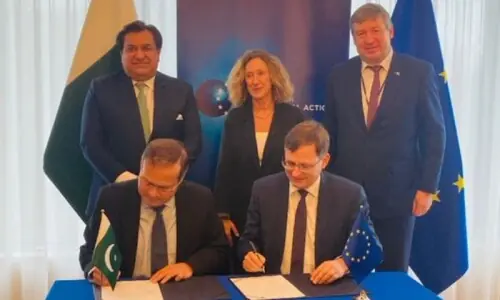
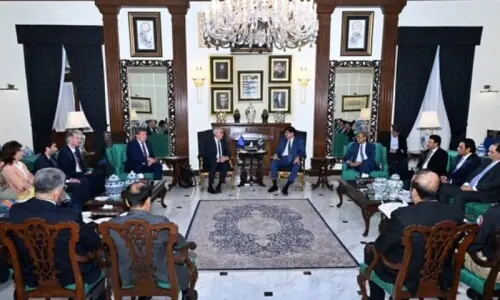
According to Saturday’s statement, the FO noted that the 15th Pakistan-EU Joint Commission meeting was held in Brussels on December 17 and that cooperation between Islamabad and the bloc in several different fields was discussed.
The meeting “reviewed Pakistan’s progress on the implementation of the 27 international conventions as required under the GSP+ framework,” the statement read, adding that Deputy Prime Minister and Foreign Minister Ishaq Dar attended the meeting of the Sub-Group on Democracy, Governance, Rule of Law and Human Rights on December 1.
“The EU welcomed progress made in bringing Pakistan’s application of the death penalty in line with international standards and encouraged further steps in this regard. It also recognised important first steps against torture, as well as the creation of a Commission on Minorities.”
However, the FO noted that the EU encouraged Pakistan to take further short-term steps ahead of the upcoming GSP+ Monitoring Report, which will scrutinise Pakistan’s progress.
The EU also “reiterated the need for further reforms in the medium and long term”.
“The EU and Pakistan notably exchanged views on freedom of expression and media, enforced disappearances, the independence of the judiciary, freedom of religion or belief, anti-Muslim hatred [and] the rights of persons belonging to minorities and vulnerable groups,” the statement read.
“Both sides underlined the importance of proportionality and appropriate safeguards and the need to continue dialogue on these concerns.”
Pakistan updated the EU on progress under the National Action Plan on Human Rights and the National Action Plan on Business and Human Rights, additionally outlining the actions of various national institutions in charge of promoting and protecting human rights across the country.
“The EU reiterated its commitment to supporting Pakistan’s efforts to guarantee the protection of all human rights, including women and children’s rights, minorities’ rights, labour and migrant rights, as well as fundamental freedoms, such as freedom of expression and opinion, including [the] growing problem of disinformation,” The FO stated.
GSP+ status was granted to Pakistan by the EU in 2014, resulting in a 108 per cent increase in Pakistani textile exports to the EU due to concessional tariffs.
In October 2023, the European Parliament unanimously voted to extend the GSP+ status for another four years until 2027 for developing countries, including Pakistan.
According to the EU’s GSP Convention Compliance Database, Pakistan has ratified 27 international conventions, most recently ratifying the International Covenant on Civil and Political Rights (1976) and the Convention against Torture and Other Cruel, Inhuman or Degrading Treatment or Punishment (1987) in 2010.
Regarding the EU’s monitoring of Pakistan, the body prioritised 13 key areas, including enforced disappearances, torture prevention, and freedom of expression and belief and minority rights.
In November, EU Ambassador to Pakistan Raimundas Karoblis said that the country needed to “do more” in terms of fulfilling its commitments under the GSP+ ahead of a review.
In an interview on DawnNewsTV show ‘Doosra Rukh’, the EU ambassador was asked about whether Pakistan needed to do more to fulfil the requirements of the scheme, to which he said: “Yes, we are saying that. We are saying that it should be, well, needs to be, to do more.”
He said it would be a periodic monitoring mission that would assess the implementation of all necessary United Nations conventions for the scheme’s application.