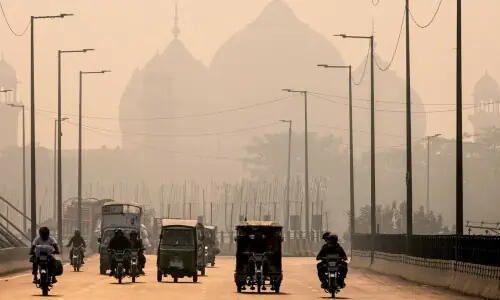
LAHORE: Lahore continued to be ranked among the most polluted cities in the world with hazardous air quality on Saturday.
According to IQAir, the metropolitan city recorded a maximum Air Quality Index (AQI) of 661 at 10am.
Within Lahore, several monitoring stations also reported high AQI readings at 8:30pm. Barki Road recorded an AQI of 457, CERP Office 447, DHA 319, Bedian Road 300, Iqbal Town 236 and Askari-X 224.
The Met Office predicted that a westerly wave is likely to approach western parts of the country from Dec 29 (night), and strengthen from Dec 30, which is expected to grip most upper/central parts on 31st and persist in upper parts till Jan 2 (morning), 2026.
Under the influence of this weather system, isolated rain-wind/thunderstorm is expected in Islamabad/Rawalpindi, Potohar region, Sargodha, Faisalabad, Mandi Bahauddin, Sialkot, Narowal, Lahore, Sheikhupura, Gujrat on Dec 31 to Jan 1, while in Mianwali, Bhakkar, Sargodha, Khushab, Noorpurthal, Layyah, Dera Ghazi Khan, Multan, Bahawalpur, Rahimyar Khan, Bahawalnagar, Muzaffargarh, Jhang and Sahiwal on Dec 31.
Meanwhile due to fog/smog, the motorways were starting to close at 9:30pm. According to a spokesperson, M-3 motorway was closed from Faizpur to Jaranwala due to smog.
He also advised the public to travel in day time and also follow lane and line on the motorways to avoid accidents.
He said that the drivers should use fog lights and also avoid unnecessary travel.
Pakistan Air Quality Initiative (PAQI) assessment has found that local emission sources are the primary contributors to the hazardous air quality levels in Pakistan’s major cities, including Lahore, Karachi, Islamabad-Rawalpindi, and Peshawar.
The report, Unveiling Pakistan’s Air Pollution: A National Landscape Report on Health Risks, Sources and Solutions, provides the country’s first multi-sectoral emissions inventories and concludes that urban smog is overwhelmingly generated within Pakistan’s own airsheds.
The report draws on satellite-derived aerosol datasets, chemical transport modelling, and PAQI’s nationwide real-time monitoring network, the largest open-data air-quality system in Pakistan to map the sources, scale, and health impacts of PM2.5 across the country’s largest cities of Karachi, Lahore, Islamabad-Rawalpindi and Peshawar. The emission profiles identified for these cities are sharply different.
In Lahore, transport, industry and brick kilns are the dominant contributors to particulate pollution, while in Karachi, industry accounts for nearly half of PM2.5 emissions. Islamabad-Rawalpindi is primarily transport-driven, and Peshawar shows the highest per-capita exposure due to transit-trade activity and valley geography.
Published in Dawn, December 28th, 2025