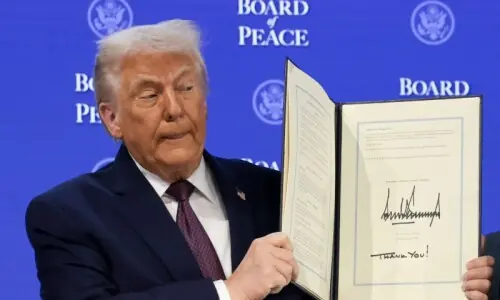

WARY of US President Donald Trump’s temperament, narcissism, shifting moods and ever-evolving agenda, the eight Muslim nations that signed the joining document of the so-called Board of Peace framed their decision intelligently, affixing it to the context of peace, rehabilitation of the Israeli-battered Gaza Strip and the question of a pathway to Palestinian statehood in line with UN resolutions.
The Pakistani parliamentary opposition makes a valid case that the matter should have been laid before the House for discussion and approval prior to any decision; but its view that joining the Board was not a prudent move is open to question. “It was the least worst [bad] option,” was the crisp comment of former ambassador Imran Ali Chaudhry, who had recently retired when the digital platform Naya Daur sought his opinion. There are a number of reasons why I tend to agree with him.
People around the world have been up in arms at the apartheid State of Israel’s genocide in Gaza starting after the Hamas attack of Oct 7, 2023. Calls from around the world fell on deaf ears as the West, led by the US, unconditionally supported, armed and facilitated the Zionist state’s assault on the Strip. Some 70,000 Gaza Palestinians were slaughtered, including about 20,000 children and a large number of women, elderly and the infirm, ie, non-combatants. But it remained business as usual as far as the genocidal apartheid state was concerned.
Whether in the hope of winning laurels or heeding his Gulf friends’ counsel, it was Trump who finally stopped the genocide. At the beginning, he was talking in terms of relocating the Gaza population and developing the Strip as the Middle East’s Riviera. Then, possibly the continuing street protests in the West, the US included, and the constant unhappiness of his well-resourced Gulf friends made him stay his hand and he made clear his plan did not envisage or include anyone being displaced from Gaza.
Pakistan has wisely sought safety in numbers and has joined the Board as part of an OIC bloc.
His announcements thus far have fallen way short of suggesting any pathway to Palestinian statehood. This is a major negative. Especially at a time when the apartheid state has accelerated evictions of Palestinians and the expansion of settlements in the West Bank.
But, despite some 450 murders of Gaza Palestinians since last October’s ceasefire by Israel, the mass killing that continued unabated for two years and claimed at the very least 70,000 lives has stopped. If joining the Board means that the magnitude of killing has stopped and many more lives saved, then perhaps it is worth it.
Pakistan has wisely sought safety in numbers and has joined the Board as part of an OIC bloc. This makes it easier in relative terms to have its voice heard. Perhaps, collectively, they can counter and dilute the apartheid state’s influence with Trump. And if the going gets too frustrating, then they can exit en bloc without one state having to face the seemingly unstable US leader’s wrath.
Let’s not forget, the US is Pakistan’s largest export market valued at between $5 billion and $6bn a year. Pakistan is also currently in an IMF programme — an institution with huge American influence, which has brought in badly needed foreign exchange injections. Coupled with meeting some of Pakistan’s military spares/upgrade needs such as the $640 million upgrade of PAF F-16 aircraft which extends their operational age to 2040, all these factors make Pakistan’s decision understandable.
In addition, Pakistan military’s performance during last May’s clash with India seems to have boosted the country’s standing in the region as well, with Trump constantly endorsing the PAF’s verified kill claims against its arch-rival, the IAF.
This element, along with effective diplomacy by the hybrid leadership, has opened up opportunities. While I wouldn’t go as far as to repeat what some analysts are saying about Pakistan being now the net security provider in the region, the defence pact with Saudi Arabia is a significant milestone.
The one interesting fact about this Board is that apart from the US, not a single UN Security Council member has joined it. Russia, China, Britain and France have so far not joined and don’t appear to be doing so either. The impact of this will become clear over time.
Many pragmatic decisions taken to safeguard the national interest may not pass the principled position test. My first and foremost concern is that the issues affecting the lives of the Palestinians in Gaza, and then the West Bank, are to be decided by an apex body that does not have a single Palestinian on it.
It will be left to other Muslim states’ representatives to carry the Palestinian mantle. Their past record of standing up for the rights of the Palestinians is not very inspiring, but the Gaza genocide seems to have shaken the most docile into sitting up and saying enough is enough. Let’s hope this isn’t wishful thinking.
As much as I want to, I don’t see this Board, with chairman Trump armed with the solitary veto and a large number of committed Zionist supporters of the apartheid state including Benjamin Netanyahu himself on it, making progress on Palestinian statehood.
But if it stops the genocide, and leads to some relief for the Gaza population and sets things on the path to reconstruction and rehabilitation it will be worthwhile. This is how powerless we are to see justice prevail in the world.
Since this Board is unlikely to last a day after Trump’s term ends, one can safely say it may not achieve much more except give the US leader another opportunity to blow his own trumpet and make largely unfounded claims of success and impact.
For Pakistan coming out unscathed at the end and more tightly aligned with Saudi Arabia, Turkiye, Egypt, Jordan, the UAE, Qatar and Indonesia would be a diplomatic and strategic win, particularly because the nation’s perennial ally China is reportedly fine with the decision.
The writer is a former editor of Dawn.
Published in Dawn, January 25th, 2026