UAE adamant it won’t allow attacks on Iran from its soil


DUBAI: The United Arab Emirates will not allow attacks on Iran to be launched from its territory, the foreign ministry said in a statement on Monday.
Last week, President Donald Trump said a US “armada” was heading toward the Gulf and that Washington was watching Iran closely after a crackdown on protesters.
The foreign ministry said in a statement it “has reaffirmed the United Arab Emirates’ commitment to not allowing its airspace, territory or waters to be used in any hostile military actions against Iran”.
The UAE hosts thousands of US personnel at Al Dhafra airbase near the capital Abu Dhabi, one of several American military bases in the Gulf.
US aircraft carrier USS Abraham Lincoln arrives in Middle East; Hezbollah chief warns any war against Iran will ignite the region
The UAE also refuses to provide logistical support for attacks, the statement said, adding that “dialogue, de-escalation, adherence to international law, and respect for state sovereignty” were the best way to address “current crises”
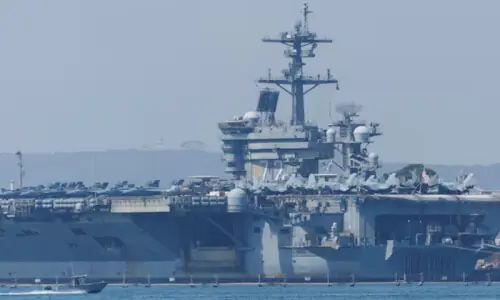
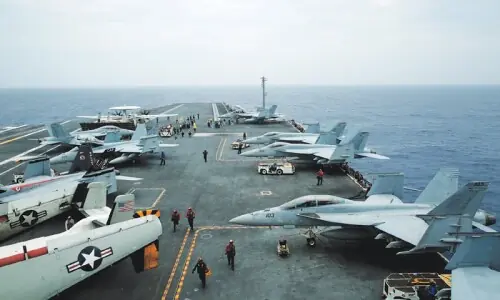
US aircraft carrier arrives in Middle East
The USS Abraham Lincoln carrier strike group has arrived in the Middle East, the US military said on Monday, dramatically boosting American firepower in the region at a time of heightened tensions with Iran.
The Lincoln and accompanying ships are “currently deployed to the Middle East to promote regional security and stability”, US Central Command said in a post on X.
Hezbollah chief’s warning
Hezbollah chief Naim Qassem warned on Monday that any war against the group’s backer Tehran this time will ignite the region as it will also target the group.
“Faced with aggression that does not distinguish between us… we are targeted by any potential aggression and determined to defend ourselves,” he said in a televised address to supporters at a solidarity rally for Iran. “We will choose at that time how to act… but we are not neutral,” he said, warning that “a war on Iran this time will ignite the region”.
Rubio’s warning to Iraq
US Secretary of State Marco Rubio warned Iraq on Sunday against a pro-Iranian government as the expected return of Nouri al-Maliki as prime minister stirs Washington’s concern.
Maliki, who left power in 2014 following heated pressure from the United States, has been chosen by Iraq’s largest Shia bloc, which would put him in line to be nominated prime minister.
Rubio, in a telephone call with incumbent Prime Minister Mohammed Shia al-Sudani, voiced hope the next government will work to make Iraq “a force for stability, prosperity and security in the Middle East”.
“The secretary emphasised that a government controlled by Iran cannot successfully put Iraq’s own interests first, keep Iraq out of regional conflicts or advance the mutually beneficial partnership between the United States and Iraq,” Rubio said, according to State Department spokesman Tommy Pigott.
An Iraqi political source said the US had conveyed that it “holds a negative view of previous governments led by former prime minister Maliki”.
In a letter, US representatives said that while the selection of the prime minister is an Iraqi decision, “the United States will make its own sovereign decisions regarding the next government in line with American interests”.
The US wields key leverage over Iraq as the country’s oil export revenue is largely held at the Federal Reserve Bank in New York, in an arrangement reached after the 2003 US invasion toppled military dictator Saddam Hussein. Iraq’s parliament meets Tuesday to elect a new president, who holds a ceremonial role but will appoint a prime minister.
A US-based rights group claimed on Monday it had “confirmed” reports of deaths of 5,848 people in a wave of protests in Iran suppressed by security forces.
Published in Dawn, January 27th, 2026