
TWO years in, the regime’s economic managers continue telling tales about streets flowing with milk and honey. Spin doctors live in an alternate reality by definition, but the extent of the spin is remarkable given that even pro-capital donors like the World Bank have acknowledged that poverty and inequality have increased markedly in recent years.
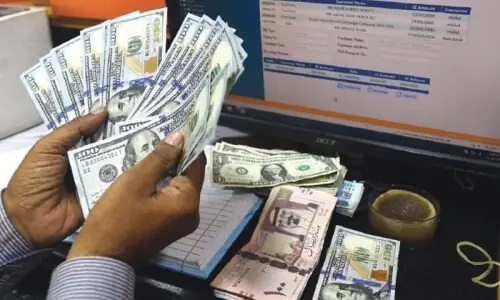
There is arguably no bigger example of the gap between how the ruling class projects its ‘successes’ and the actual conditions of working people than the inordinate focus on foreign remittances. By going on about the contributions of overseas Pakistanis being major contributors to the country’s ‘economic recovery’, the regime implies that this is one of its great achievements.
The numbers are certainly eye-catching. According to the International Organisation for Migration, remittances reached a record high of $34 billion in 2024. This is equivalent to almost 10 per cent of GDP, making Pakistan’s one of the highest remittances-to-GDP rates in the world. Most of this money goes into household consumption, with real estate and small/medium enterprises (SMEs) the other two major recipient sectors.
One only has to scratch slightly beneath the surface to reveal what the numbers really mean. The vast majority of Pakistanis abroad are engaged in low-skilled occupations, often informal and precarious, especially in Saudi Arabia and the UAE. The Gulf migrations began in the 1970s and have produced social mobility for millions of largely rural households for decades. But that should not distract from the typically poor working conditions, racism and repression to which migrant workers are subjected in ‘Muslim brethren’ countries. It is also the case that the demand for labour in the Gulf kingdoms has decreased over time.
There are many Pakistanis abroad in the high-skilled labour bracket too, some of whom left decades ago, and some who continue to leave today. They are the ones who tend to invest in real estate, moving their money from one speculative investment to the next, one of the reasons why so many plots in gated housing schemes are actually unoccupied.
What do the remittances figures actually reveal?
The number of migrants in both low- and high-skilled labour brackets has increased considerably in recent years. The Bureau of Emigration & Overseas Employment recently disclosed that 762,499 Pakistanis emigrated abroad in 2025. This is a considerable understatement; many who migrate abroad initially leave on student visas but have no intention of returning, becoming part of the precarious immigrant labour force mentioned above. Even more have no visa at all and leave via human smuggling rackets that promise a new home in European destinations like Greece and Italy. A significant number never make it, and disappear forever, or end up in limbo in countries like Iran and Afghanistan. Families who are lucky enough to track them down spend millions in bribes to get them back home. Many of these rackets, as we have seen recently, are run with the connivance of government departments like the FIA.
To harp on about the great contribution of remittances to Pakistan is to live in a make-believe world about the social and economic hardships and uncertainty about the future that are compelling more and more people to leave, including even those from relatively well-to-do backgrounds. Labour is now Pakistan’s biggest export, above and beyond any single physical commodity. This is not about to change.
For all the talk about enhancing exports, the fact is that this regime is outdoing even those that preceded it in accumulating short-term debt, promoting conspicuous consumption, and engaging in resource grabs.
There are more and more high-profile SIFC-fronted conferences with fancy claims about ‘mineral sector transformation’ and capital-intensive agriculture, but all of these revolve around the imperatives of capital, not labour.
It has been said before but it merits repeating that four million young people join the labour force every year. The opportunities for gainful employment are decreasing in parallel to the burgeoning supply of labour. This is why the number of people seeking to emigrate abroad is now touching one million a year.
None of the sectors where remittances are coming in are labour-absorbing. The real estate sector is amongst the biggest banes of our collective existence; not only does it create no jobs, it is sustained by land, water and forest grabs that are hastening environmental collapse. Then there is the SME sector, which may constitute a vital part of the informal economy, but cannot compensate for the absence of meaningful and broad-based industrialisation. The resort to more repression cannot hide the failure of this and previous regimes to provide for Pakistan’s young working masses.
The writer teaches at Quaid-i-Azam University, Islamabad.
Published in Dawn, January 30th, 2026