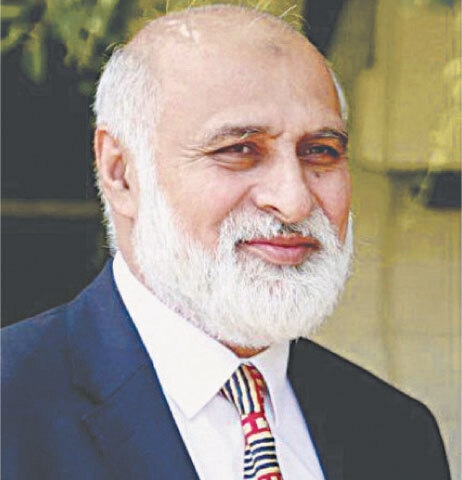
ISLAMABAD: After a gap of more than six months, the Higher Education Commission (HEC) finally has a chairman, as Prof Dr Niaz Ahmad Akhtar (Sitara-i-Imtiaz) assumed office on Friday with what he described as a comprehensive reform agenda to revamp the country’s higher education sector.
Insiders say the new HEC chief will face several challenges, including arranging adequate funding for universities, introducing changes in the governance system at HEC, and resolving issues faced by faculty members and university administrations.
Dr Akhtar, who, before joining HEC, served as Vice Chancellor of the Quaid-i-Azam University (QAU), is said to be cognisant of the issues confronting the struggling higher education sector. Even on his first day in office, sources said, he took up the issue of funding shortages for universities with the federal government.
“You will see drastic and visible changes in the higher education sector,” he said while speaking to Dawn after taking charge.
Prof Niaz Ahmad Akhtar takes charge as chairman, vows reforms amid funding crunch, governance challenges
“The federal government wants to strengthen HEC and universities. We will start reforms in this sector to equip teachers and students,” he said, adding that at the HEC Commission meeting on Monday he would propose the establishment of a Graduate Employment Cell.
“We will also set up a research fund. I do agree that a lot of work needs to be done in the higher education sector, and we will take every possible step to bring improvement,” he said, adding that he has a complete plan covering quality assurance, curriculum development, digitisation and international linkages.
“We will work with European and US universities,” he said, adding that he would share complete details of his new vision in the coming days.
“We will focus on strengthening quality assurance, fostering research through global partnerships, promoting industry-oriented academic programmes, and enhancing faculty development to advance Pakistan’s higher education, with the aim of developing a knowledge-based economy,” he said.
Asked about governance issues at HEC that surfaced in recent years due to infighting among some officials, Dr Akhtar said, “I will ensure that all wings of HEC remain in order for effective service delivery. Our main focus is to help universities produce quality graduates for the country’s progress.”
Responding to a query about the fate of the vice chancellor’s office at QAU, he said the federal government and the Ministry of Education would assign charge to someone from QAU to run the office until the appointment of a regular incumbent. Sources said that traditionally, the government appoints a senior dean or the senior-most professor as acting vice chancellor.
It is relevant to note that in the fiscal year 2025-26, the higher education sector saw a major funding cut in the federal budget. The government allocated Rs39.4 billion for development projects, far less than the Rs66.3 billion earmarked in 2024-25.
Similarly, for the ongoing year, an amount of Rs66.4 billion has been allocated for recurring grants (non-development expenditure), compared to Rs65 billion in 2024-25. Overall, recurring funds have remained almost stagnant for many years, while pensions, salaries and utility expenses have continued to rise. Dr Akhtar, who secured a special grant of Rs2 billion for QAU last year, is well aware of this major issue facing public sector universities.
“This issue is my top priority, and in the upcoming federal budget we will secure the required funds from the government,” he said.
Meanwhile, a press release issued by HEC stated that upon his arrival at the HEC Secretariat in Islamabad, the new chairman was received by Executive Director HEC Prof Dr Zia Ul Haq, along with senior HEC officers.
“With over 35 years of experience in higher education, research and institutional development, Dr Akhtar is the most senior vice chancellor in the country, with a cumulative 16 years of experience leading six prestigious institutions. He also served as vice chancellor of the Pakistan Engineering Council (PEC) for three terms,” the press release said.
It added that a scholar of international standing, Dr Niaz holds a PhD in Chemical Engineering from the University of Leeds, United Kingdom. He has published numerous peer-reviewed articles, authored or edited four books, and supervised 12 PhD students in Chemical Engineering and Total Quality Management (TQM).
Published in Dawn, February 7th, 2026