Use of maggots for determining time of death
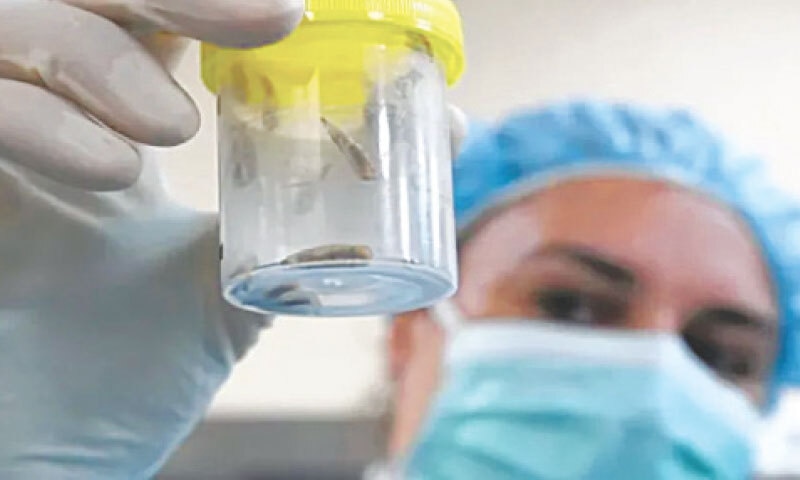

Imagine a job collecting and analysing insects found on human remains to determine the time of death. That’s what forensic entomologist and Universiti Malaya senior lecturer Dr Tania Ivorra does.
While forensic pathologists can estimate the postmortem interval (the duration between the time of death and the examination of the body) if death has occurred within 72 hours, forensic entomologists are called in if death has occurred after 72 hours.
This is as they are able to estimate the time of death using the development of insects and other arthropods found on or near a decomposing body. Insects arrive in a predictable sequence, with development influenced by environmental factors like temperature.
Dr Ivorra explains: “Before 72 hours, the changes in the body processes are different, but after that period, insects help us find a more specific time range of death. “Within minutes, insects can detect the smell a dead body produces that humans cannot detect.
“But if the body was found in a house that was completely closed or airconditioned, insects have difficulty accessing the body, so there could be a bit of delay. “It all depends on whether the doors were open, whether the body was found in a car with windows closed, etc.”
If death occurs outdoors, the insect colonisation will be faster. The first to arrive are flies, then beetles, and in very advanced decomposed or mummified states, a variety of insects. Basically, there are three insect families that are abundant in a decomposed body: family Calliphoridae, family Sarcophagidae and family Muscidae.
“Again, it depends on the environmental condition and temperature. “Insects go through four life stages: egg, larvae, pupa and adult. “So, if I find pupa, then I know this is an advanced life stage.
“If I find only larvae, I know this is the early stage and I will identify the type of species. “We can’t give an exact time of death as it is very complicated, so we give a range – minimum and maximum postmortem interval,” she says.
Both the forensic pathologist and forensic entomologist collaborate to establish a more accurate post-mortem interval, in case the court requires evidence. Sometimes, forensic pathologists also go to the crime or death scene to pick out clues, although Dr Ivorra has yet to do so. “Yes, my work is to collect maggots for research in the field and the lab.
“The insects that we find only feed on necrotic tissues – they won’t do anything in a live human,” she says. However, she points out that in Malaysia, some fly species cause myiasis, an infestation where larvae feed on live tissues of vertebrate hosts.
One species is Chrysomya bezziana, commonly known as Old-World Screwworm.
“This is an obligatory myiasis agent, which means they look for open wounds that are not clean to lay their eggs.
“The larvae will feed on the tissues because they need live tissues to survive, unlike the ones found on decomposed bodies,” says Dr Ivorra. In the forensic entomology lab, the insects collected are mostly fed with beef liver for the scientists to observe their life cycle. Indeed, the place smells similar to rotting flesh.
She says: “It’s not something that impacts us too much because we are used to this type of smell.” In this postmortem case, Dr Ivorra and her team are still determining which family the larvae and pupa are from.
“”We need to rear them until the adult stage so we can see the whole life cycle, hence we cannot give the results now – it’ll take a few weeks,” she says. This is one of the reasons why post-mortem reports take a long time to come out.
Published in Dawn, February 9th, 2026