LAHORE: After a relatively strong parliament emerged in 2008, Pakistan transitioned into a state of a ‘creeping coup’ in the 2018 elections, which worsened in the 2024 general elections and democracy and the constitution have derailed.
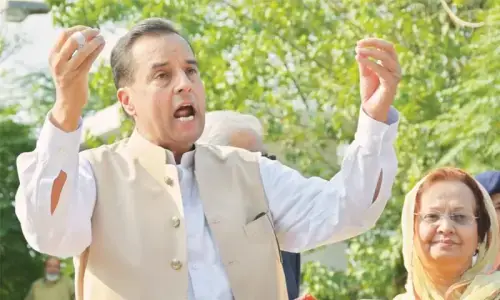
This was said during the closing ceremony of the 6th Asma Jahangir Conference titled “Dialogue for Democracy: Power to the People” on Sunday in Lahore. Leaders from all political parties shared the stage with National Party’s Dr Malik Baloch, PPP’s Nafisa Shah, PTI’s Ali Zafar, and PML-N’s Parvaiz Rasheed, National Democratic Movement President Afrasiab Khattak and former Senator Farhatullah Babar were among the speakers. The session was moderated by Journalist Munizae Jahangir.
Opening the session, Ms Jahangir said the country was faced with a crisis where short-term enforced disappearances targeted political parties, political activists, civil society activists and journalists. She also pointed out the extrajudicial killings in police encounters in Punjab on a daily basis. She said that press clubs had become off-limit. “There was a time when press clubs used to be a safe space even during the times of General Zia and General Musharraf,” she added.
She said that Peca was used against politicians, and now it was being used against activists and journalists. She said that politicians who used to speak up about the lesser-developed areas were not behind bars. “We also need to take step to ensure that the next election does not result in the kind of political polarisation that exists in Pakistan today,” she said.
Mr Khattak said that the 2018 and 2024 elections were rigged, which derailed democracy in Pakistan. He said, “The coup is ongoing, the first theft of the election was in 2018 and the second in 2024. As a result, Pakistan’s democracy has derailed and the country is unstable”. He said that as a result, the democracy and the constitutional system had weakened. He asked the participants whether they were waiting for the elections to be stolen the third time.
Mr Babar agreed on the ‘creeping coup’ thesis of Mr Khattak and said that a parallel legal system had now been established. He said the Constitution was not being followed and citizens were living in a constitution-less state. He said the last year’s conference also discussed that the constitution was not being followed and two examples were discussed, the establishment of the SIFC and apex committees, which had no grounds in the constitution. He said that in the last year, further erosion of the Constitution had taken place as the creeping coup continued.
Ms Shah said, “Since 2018, Pakistan has evolved a hybrid model of governance, where democratic institutions coexist with pronounced military influence, especially in foreign policy, national security, and defense”. She said that this ‘hybrid order’ emerged in the aftermath of the Charter of Democracy, which was meant to be a roadmap for strengthening civilian authority. She said that the creeping coup of 2014 targeted the very parties that had signed the Charter of Democracy through arrests, fabricated cases, and public vilification. “Ironically, the party that once benefited from hybrid rule now finds itself the primary casualty. Political polarization engineered to create a third force has left lasting scars on our political culture,” she added.
Mr Achakzai pointed out that the state wanted the eraser of different identities when Pakistan came into being in 1947. He said that resistance to this denial of identity became the starting point of Pakistan’s downward trajectory, including its long-term internal instability. He said that experiments were being conducted in the country in which leaders were invented, funded, blackmailed, and then made prime ministers. He said, “For 75 years, we see the army being recruited from only four districts. How many Sindhis, Saraiki or Baloch are in the army? We want to also take part in governing this land - give us our right to rule”.
Earlier, during various forums panelists demanded that human rights activists Mahrang Baloch, Ali Wazir and Imaan Mazari and Hadi Ali Chatha be released immediately. They also demanded that curbs and false cases on journalists must be seized, new laws such as Peca and tribunals were being used against dissent, these laws must be repealed and laws on cybercrimes, incitement and harassment must be properly formulated for protection of the citizens.
Published in Dawn, February 9th, 2026