IHC’s Justice Minhas questions what constitutes ‘fake news’ in Peca amendments
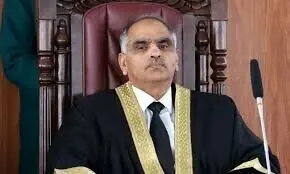

ISLAMABAD: Justice Raja Inaam Ameen Minhas of the Islamabad High Court (IHC) on Monday questioned the mechanism for determining what constitutes “fake news” in the amended Prevention of Electronic Crimes Act (Peca).
The IHC judge made the remarks while hearing petitions filed by journalists’ bodies and senior journalists challenging the controversial amendments to Peca, which they argue curtail freedom of expression and vest excessive powers in the executive.
The petitions have been filed by senior journalist Hamid Mir, the Pakistan Federal Union of Journalists (PFUJ), the Islamabad High Court Journalists Association (IHCJA), and others.
During the hearing, the counsel for the petitioner read out the added provisions of the amended law and contended that powers traditionally exercised by the judiciary had been transferred to the executive through the amendments.
The counsel argued that matters relating to the determination of false or fake information should be adjudicated by an independent judicial tribunal constituted in consultation with the chief justice of Pakistan, rather than by executive authorities.
Referring to Section 2C of the amended law, which deals with a ban on fake and false information on social media, Justice Minhas raised a series of critical questions.
“Who will decide whether the information is fake or false?” the judge asked, seeking clarification on the procedure and standards laid down in the law. “Explain how fake news will be determined. How will proceedings regarding fake news begin?” he further inquired.
In response, the petitioner’s counsel submitted that the amended law introduced a new mechanism for filing complaints, under which not only the aggrieved party but also a third party could initiate proceedings.
“This provision opens the door for proxies to file complaints, which will inevitably lead to misuse of the law,” the counsel argued. He added that it was essential to assess the actual harm caused by the alleged fake information, as not every incorrect statement amounted to disinformation.
“Fake information can also be the result of an error that does not cause harm to anyone,” he said.
During the proceedings, Rawalpindi-Islamabad Union of Journalists (RIUJ) President Asif Bashir Chaudhry also addressed the court.
He informed the bench that PFUJ had approached the court against Peca on February 6 last year, but the case had remained pending without any stay order.
He claimed that during this period, more than two dozen journalists had been sentenced to life imprisonment. He also referred to a case registered against a journalist who had reported the use of substandard materials in road construction, which later led to the road’s early demolition.
In response to the petition, Justice Minhas observed that the matter involved legislation enacted by parliament and reiterated that such a law could not be suspended through a restraining order at the interim stage.
“This is legislation. It cannot be suspended through an interim order,” the judge remarked, adding that the court would decide the matter after hearing detailed arguments from all sides.
The court subsequently adjourned the hearing until March 6.
Peca, since its introduction in 2016, has been widely criticised as a “black law” created mainly to punish dissent. Last year, new provisions in the law introduced harsher penalties for what the government considers “fake news”, the expansion of state oversight of digital platforms, and the creation of new regulatory bodies to monitor social media.
At the time of its passage, Amnesty International had warned that the proposed changes to the country’s cybercrime laws could “further tighten the government’s grip over Pakistan’s heavily controlled digital landscape” if enacted into law.
The Human Rights Commission of Pakistan (HRCP) had also expressed concern that amendments “would curb fundamental rights.”
In August 2025, the Senate Standing Committee on Information and Broadcasting showed its concern over registration of cases against journalists under Peca and called for urgent action to address growing concerns of media persons regarding FIRs and arrests of journalists.