Time for internal unity

And hold firmly to the rope of Allah all together and do not become divided” — The Holy Quran (3:103)
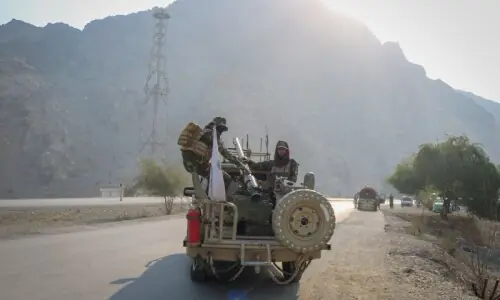
WE are in a state of war with Afghanistan and we are sitting on the edge of a regional war, if not World War III. There is no single standard definition of a world war but definitely it is an international war since ‘international’ is widely understood to involve two or more countries. It is a multinational war in any case.
Well-known political commentator Thomas Friedman titled his recent column (March 2) in the New York Times ‘How to think about Trump’s war with Iran’. This is a very apt title of a very complicated Middle East situation and it is not easy to think straight about it. There are more questions than answers and the answers depend on whom you ask. One can peel off layer after layer of the ongoing war to reach the root causes. It can be an endless exercise. Again, the final answers would depend on who is doing the peeling.
What does it mean for the people of Pakistan? After the East Pakistan debacle, I don’t think Pakistan has faced a more difficult situation — this is a tough balancing act as we are walking on a tightrope and juggling multiple balls at the same time.
Compounding an already complicated external situation are our deep internal political divisions and egoistic conflicts — a government lacking legitimacy due to a fraudulent election; an underdeveloped, shamelessly extractive and debt-ridden economy; falling real incomes and unemployment not seen in the last 21 years; rising poverty; deteriorating living conditions; ongoing terrorism in two provinces; and an insurgency gathering strength in Balochistan, which has a long border with Iran. And now, we have a war with Afghanistan on the north-western front; Iran burns to our west; while India to the east, still licking its wounds from last May, is ever-ready to harm us.
If all of this is not considered serious enough for us to be honest with ourselves, then we are hell-bent on self-harm. Serious introspection is in order. The decision-makers in Pakistan need to take a deep breath and exhale slowly; it will really help them clear their minds. They need to take a few steps back to take a holistic view of the situation and then rise to the occasion. The situation today cries out for a fundamental paradigm shift regarding how this country must be run — in the name of the state that we have vowed to defend and work for.
Only an internally robust, united Pakistan can deal with a complex, dangerous external world.
The starting point of this paradigm shift has to be how we understand the word ‘state’. The state is its people. This is why our Constitution begins by saying in its preamble that “we the people of Pakistan … give to ourselves, this Constitution”, and that “…it is the will of the people of Pakistan to establish an order”, and “wherein the state shall exercise its powers and authority through the chosen representatives of the people”, and “where in the principles of democracy, freedom, equality, tolerance and social justice, as enunciated by Islam, shall be fully observed”.
The state, the people, create different institutions to ensure the implementation of the Constitution — which all members of different institutions take oath to uphold — and the laws that flow from it. This is the foundation on which everything else is built in a modern state and if this is not strong enough then anarchy will befall the state.
Today, the conflict and chaos that we see in our country is fundamentally because the people — and I mean all of us — do not uphold the Constitution and do not believe in the rule of law or the equality of citizens. The current external and internal crisis requires, first and foremost, all of us to repeat, from the depths of our hearts, our vows to the Constitution of Pakistan. Once this is done, everything else will start falling in place.
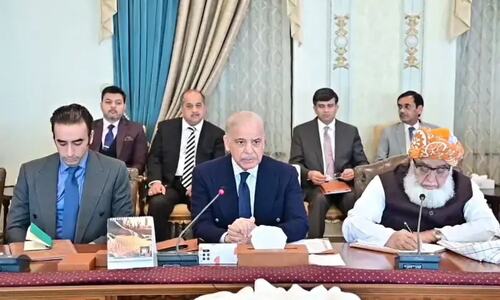
More urgently, all political leaders inside both houses of parliament need to embrace each other in the name of Pakistan — both, those on the treasury benches and those in the opposition. For now, the opposition should forget even the legitimacy question hanging over the government because this is a time of emergency.
At this time, both houses of parliament must discuss our foreign policy, develop a consensus and take people into confidence. Senior parliamentarians’ delegation consisting of members from both sides of the aisle, along with some senior and credible statesmen and civil society leaders, must initiate an effort at national unity and reconciliation. This delegation must hold meetings in each province by inviting civil society representatives and representatives of nationalist parties, including the angry ones. They should also meet the heads and senior leaders of all key national institutions, especially the judiciary, civil bureaucracy and the armed forces.
This group must also meet the imprisoned Imran Khan, with the assurance that his cases and appeals will be decided by the courts without unnecessary delay. I am sure with the grave dangers looming over Pakistan and for the sake of the country, if approached properly, a mutually agreed solution can be found by keeping in view the larger national interest. The same reconciliation process must extend to all other political prisoners as well.
Pakistan desperately needs sustainable structural reforms in all its sectors and institutions. For this, all political parties must confer and develop a shared long-term vision for national development and firewall it against any political change in the country. There has to be a process to ensure this. Pakistan needs national unity more than ever before. Such an initiative, or a modified form of it, if carried out sincerely, can help provide the long-awaited healing touch. Now is the time to do it. Only an internally robust and united Pakistan can deal with an increasingly complex and dangerous external world.
The writer is a former SAPM on health with ministerial status, adjunct professor of health systems and president of the Pakistan Association of Lifestyle Medicine.
Published in Dawn, March 6th, 2026