‘Hey, Cuba’

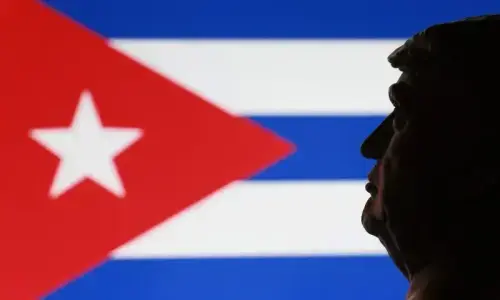
THE casual way in which US President Donald Trump has talked about ‘taking Cuba’ is being discussed worldwide, including in the American media. We in Pakistan need a reminder of why we should care about what happens across the oceans to a small island nation. You might ask, why. Because we owe them a lot, just as everyone who cares about the rights of people suffering from aggression and foreign occupation owes them — from Palestine to South Africa, from Kashmir to Vietnam, Cuba has supported them. There may also be lessons for us in this.
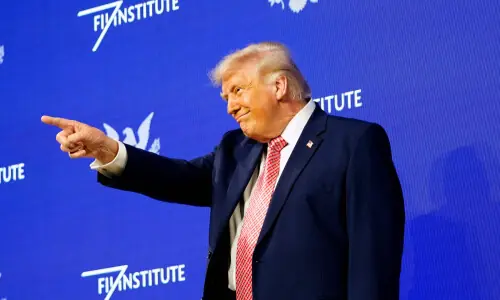
Trump was recently quoted as saying, “You know, all my life, I’ve been hearing about the United States and Cuba. You know, when will the United States do it? I do believe I’ll be having the honour of taking Cuba.” When asked by a journalist what exactly he meant by ‘taking Cuba’, Trump said, “Taking Cuba in some form … I mean, whether I free it, take it, think I can do anything I want with it.”
Do you wonder why Washington has an itch for regime change in Cuba, despite its lack of oil and rare minerals that the US is desperately seeking worldwide? Jon Lee Anderson, the author of To Lose a War: The Fall and Rise of the Taliban, who recently wrote a piece in the New Yorker on Trump’s fulminations about Cuba, was asked about it by Terry Gross in an interview for her podcast Fresh Air, broadcast by National Public Radio recently.
Anderson, who has spent significant time in Cuba researching his book on Che Guevara, offers a quote-worthy response: “Well, it’s a 700-mile-long Caribbean island with unexploited, undeveloped beachfront property. Let’s put it that way, it’s a real estate tycoon’s dream of dreams.” Surprised? We shouldn’t be. Trump would not tire of talking about transforming Gaza into a Riviera of the Middle East during the peak of Israel’s genocide following the Hamas attacks on Oct 7, 2023. Real estate developers and nuclear weapons always evoke a sense of foreboding; a dangerous mix of unchecked ambition, lack of scruples and few brain cells.
The Cubans have a heart the size of America.
For those fortunate and wise enough not to earn a degree in international relations, here is a recap of how Cuba ended up where it is today: The US-backed Gen Batista regime was overthrown in a revolution led by Cuba’s own Fidel Castro and the Argentine Che Guevara in 1959. The US imposed a trade embargo on Cuba. Castro sought US support, but president Eisenhower refused to speak with him. Castro turned to the Soviet Union for ideological support and for sugar exports in exchange for oil. In 1961, the CIA orchestrated the Bay of Pigs invasion. They attempted a regime change by parachuting 1,400 CIA-trained dissidents into Cuba; they were supposed to lead a popular uprising against Castro, aided by US air force cover. President John F. Kennedy reneged on that promise at the last moment, and all intruders were killed or captured by Cuban forces. The first time the world came close to a nuclear confrontation after World War II was when Nato moved nuclear-capable missiles to Turkiye. In response, the Soviets deployed similar missiles to Cuba in 1962. Eventually, Kennedy and Nikita Khrushchev agreed to withdraw missile batteries from their respective bases.
After the Soviet Union’s collapse, Cuba relied mainly on Venezuelan oil under both Hugo Chávez and his successor, Nicolás Maduro. With Maduro’s kidnapping by the US in January, Cuba is starved of almost 80 per cent of its oil supply and 40pc of remittances from the Cuban diaspora in the US.
Oil or not, the Cubans have something that no one else does. A heart the size of America. During the 2005 earthquake, Cuba sent 2,400 doctors and paramedical staff to Pakistan, established 32 field hospitals and two aid camps, carried out numerous transport flights and provided tons of medicines and medical equipment. Cuban aid workers treated more than 1.7 million patients, performed over 14,000 surgeries, and provided rehabilitation services to 166,000 quake-affected persons. Cuba has provided scholarships to more than 1,000 medical students who return home, proudly calling themselves ‘Cuban doctors’.
We also depend on imported oil from benefactors under stress; our reliance on remittances from Saudi Arabia and Gulf countries at war exceeds Cuba’s reliance on expatriates in the US. Tulsi Gabbard, director of National Intelligence, has told the US Senate that Pakistan’s missile capability poses a significant future threat to the homeland.
By the way, the hero in the iconic barrette was named Ernesto Guevara; he earned the nickname ‘Che’ because of his habit of using the Argentinian slang interjection meaning ‘hey, listen’, etc. We also have undeveloped beachfront real estate that many are eyeing. Che Pakistan!
The writer is a poet. His latest publication is a collection of satire essays titled Rindana.
Published in Dawn, March 30th, 2026