Pakistan walks into IMF meetings in DC amid war shocks

• Finance minister to hold key talks with Fund, World Bank officials through April 17
• Islamabad to seek safety nets, subsidy reforms, emergency financing options
• Oil, gas volatility threatens Pakistan’s reserves, widens current account gap
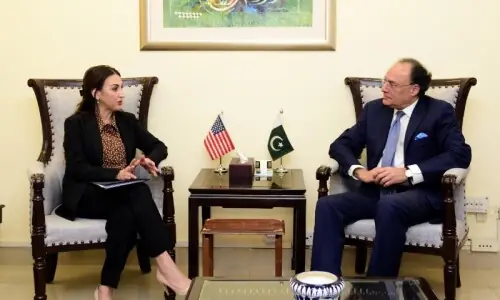
WASHINGTON: Finance Minister Muhammad Aurangzeb is expected in Washington on April 11 for the 2026 Spring Meetings of the International Monetary Fund and the World Bank, a visit that has acquired added significance as developing economies grapple with the widening economic fallout of the ongoing war in Iran.
Mr Aurangzeb is scheduled to remain in the United States through April 17. During his visit, he will hold a series of bilateral and multilateral meetings with senior officials of international financial institutions and other stakeholders. The minister will also address Pakistani media on April 17 before departing for Islamabad.
The Spring Meetings, set for April 13–18, will bring together finance ministers, central bank governors, policymakers and development experts from across the globe at a time of heightened economic uncertainty.
Beyond the formal plenary sessions, Aurangzeb is expected to engage in consultations with IMF and World Bank officials on mitigating the spillover effects of the Iran conflict, particularly for low-income and energy-importing countries such as Pakistan.
In recent days, the IMF, the World Bank, and the International Energy Agency have announced a joint coordination mechanism to help countries navigate the economic disruptions triggered by the war.
The initiative aims to “strengthen real-time monitoring of global energy markets and assess the broader macroeconomic consequences of supply disruptions, price volatility and financial market stress”.
The coordinated effort is designed to track energy price spikes, inflationary trends, trade flows and supply-chain bottlenecks, while aligning policy advice and potential financial assistance. This may include concessional financing, emergency liquidity support and risk-mitigation tools tailored to countries facing acute balance-of-payments or fiscal pressures.
The IMF has cautioned that the conflict has “injected sharp volatility into global oil and gas markets, tightened financial conditions and driven up the cost of essential commodities, including food and fertiliser.”
Such pressures, the Fund notes, could exacerbate inflation and slow growth, particularly in energy-importing developing economies with limited fiscal space.
Rising fertiliser prices also pose a secondary risk to food production in agrarian economies, potentially amplifying food insecurity and social pressures if supply constraints persist. Multilateral institutions have stressed the need for carefully calibrated policy responses that protect vulnerable populations while preserving macroeconomic stability.
For Pakistan, the implications are significant. Higher energy import costs would widen the current account deficit and strain foreign exchange reserves. Elevated global prices for fuel, food and agricultural inputs could further intensify domestic inflation and complicate fiscal management.
Mr Aurangzeb’s consultations in Washington are therefore expected to focus on a mix of short-term cushioning measures and medium-term reforms. Discussions may include targeted social safety nets, rationalisation of energy subsidies, prudent monetary and fiscal coordination, and access to contingency financing instruments to manage external shocks.
The IMF and World Bank have underscored that the Iran conflict is not merely a regional geopolitical crisis but a catalyst for broader global economic stress. They have emphasised the importance of coordinated international responses to prevent energy disruptions from triggering prolonged instability in vulnerable economies.
Mr Aurangzeb’s meetings in Washington come at a critical juncture, as Islamabad seeks both policy guidance and financial reassurance to navigate the uncertain months ahead.
Published in Dawn, April 3rd, 2026