Galactic lunacy


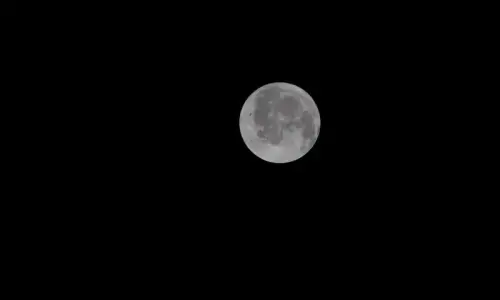
IT seems we’ve been fascinated by the moon since the earliest days. The ‘we’ includes not just humans but other creatures as well. Many companies use the myth-inspired wolf howling at the moon logo.
There’s folklore about the Chakor circling the moon as a symbol of unrequited love. The idea that erratic mental conditions are caused by moon phases led to the term ‘lunatic’, meaning ‘moonstruck.’ Science shows that the rise and fall of ocean tides are driven by the moon’s gravitational pull.
Yuri Gagarin, a Russian cosmonaut, was the first human to orbit the Earth in 1961. American astronaut Neil Armstrong took the famous ‘one giant leap for mankind’ by walking on the moon in 1969. As is common in this part of the world, we stuck to our usual claim, that is, ‘did it before everyone else’, albeit in that near-lunatic state called poetic inspiration. In our Indo-Persian cultural tradition, this closest of celestial bodies is likened to the most divergent objects and relations, such as the beloved’s face and the maternal uncle. The majority of Muslims still determine the religious calendar and festivals by the moon phases.
While the faithful around the world are open to using scientific, more accurate methods to determine the Earth’s movement, segments of the clergy insist on sticking to tradition and sighting the moon to guide the lives of billions of Muslims. Despite the important work undertaken by Muslim scientists during the ‘Golden Age’, of late our interest in the moon has been limited to the possibility of multiple honeymoons. In fact, our complacency in ‘reaching for the stars’ could be evinced by the vehemence with which certain quarters still deny the human landing on the moon. If it is any solace, the so-called developed world, including Europe and North America, has a sizeable community of deniers despite the 382 kilograms of moon rock brought back by various missions.
Our interest in the moon is restricted to multiple honeymoons.
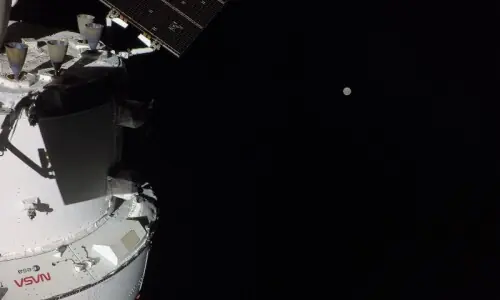
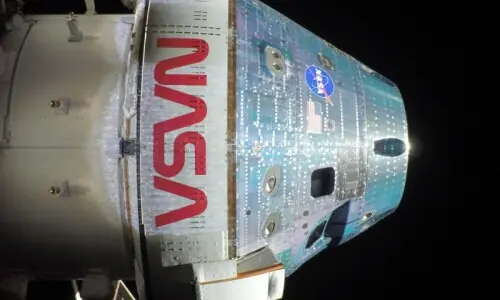
The Cold War rivalry between the America and the Soviet Union led president John F. Kennedy to vow in 1961 that the US would land a human on the moon within the decade. Many other nations have since joined the space race, sending satellites and bringing back samples. After a hiatus of a few decades, the race to claim outer space was reignited by private companies, mainly Elon Musk’s SpaceX and Jeff Bezos’ Blue Origin. What started out as space tourism has evolved into a frantic rush to colonise space and establish permanent stations on celestial bodies such as the moon.
As long as it was focused on scientific research and the adventures of the wealthiest individuals, it was somewhat acceptable. However, it was only a matter of time before those exhausting Earth’s resources and destroying its environment would seek to colonise every available ‘foothold’, even in outer space, and monopolise alternative habitats for those who can afford it.
An extremely alarming aspect has been added to the nuclear holocaust scenario. Since the invention of nuclear weapons, people have feared a post-apocalyptic world, often described as a 1,000-year nuclear winter, with nothing but layers of permafrost or a scorched-earth landscape lacking all vegetation. In such a doomsday scenario, the search for an alternative living space becomes even more urgent. It is strange that those rushing to create habitats in space are planning to build nuclear stations on the moon to support a permanent human presence.
The destruction wrought on Hiroshima and Nagasaki by the Americans did not stop the world from developing nuclear weapons and their delivery systems. Accidents like Chernobyl in Ukraine and the Fukushima Daiichi nuclear disaster in Japan slowed the construction of new nuclear power plants, but only temporarily. It takes a certain kind of nihilism to develop a technology capable of destroying the only habitat for living organisms, plan for such a disaster, and then decide to transfer the very source of the feared destruction to a still-imaginary new home.
While our poets can lounge about in the moonlight, the ‘developed’ world seems to have accepted Faiz sahib’s challenge — “Jalwa gah-i-visal ki shamein, woh bujha bhi chukai agar tau kia/ Chand ko gul karein to hum janein” (So what, if they blow out the candles in the lovers’ chamber/ Dare them to snuff out the moon).
For now, the moon’s fate can be summarised in a line by Akhtar ul Iman: “Chand phiki si hansi hans ke guzar jaata hai” (The moon passes by with meek mirth).
The writer is a poet. His latest publication is a collection of satire essays titled Rindana.
Published in Dawn, April 7th, 2026