10-day ceasefire between Israel, Lebanon takes effect

A 10-day ceasefire deal agreed between Lebanon and Israel took effect on Friday while US President Donald Trump said he was trying to set up the first-ever meeting between the leaders of the two countries.
The ceasefire was announced by Trump on Thursday.
Israel has been carrying out deadly attacks in Lebanon against the backdrop of a now-paused US-Israeli war on Iran. The war spilled into Lebanon on March 2, with an attack by Hezbollah against Israel.
Israeli attacks have killed more than 2,100 people in Lebanon since and forced more than 1.2 million to flee, Lebanese authorities say. Israel says Hezbollah attacks have killed two Israeli civilians, while 13 Israeli soldiers have died in Lebanon since March 2.
Trump announced the agreement between the two sides on a ceasefire in a Truth Social post, saying that he had “excellent conversations” with Lebanese President Joseph Aoun and Israeli Prime Minister Benjamin Netanyahu.
“These two Leaders have agreed that in order to achieve PEACE between their Countries, they will formally begin a 10 Day CEASEFIRE at 5 P.M. EST,” Trump announced.
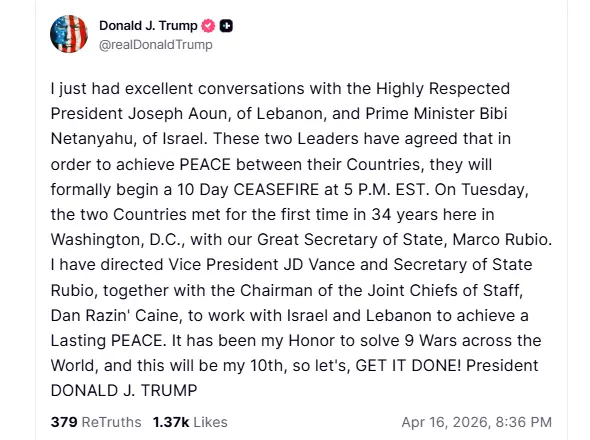
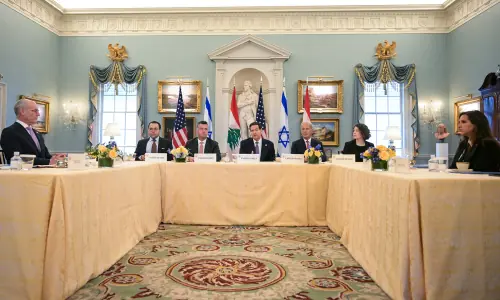
Referring to the talks held between the two sides in Washington, he said the two “countries met for the first time in 34 years here in Washington, D.C., with our Great Secretary of State, Marco Rubio”.
“I have directed Vice President JD Vance and Secretary of State Rubio, together with the Chairman of the Joint Chiefs of Staff, Dan Razin’ Caine, to work with Israel and Lebanon to achieve a Lasting PEACE. It has been my Honor to solve nine Wars across the World, and this will be my 10th, so let’s, GET IT DONE!” he added.
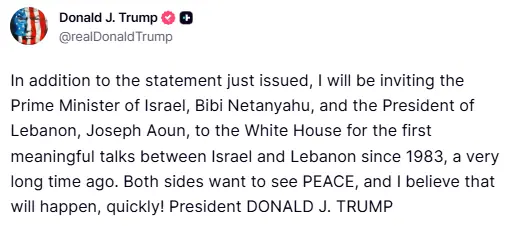
In a subsequent post, he said he would invite Israeli Prime Minister Benjamin Netanyahu and Lebanese President Joseph Aoun to the White House for the “first meaningful talks” between the two countries since 1983.
“Both sides want to see peace, and I believe that will happen, quickly!” Trump said.
Later, the US State Department said the ceasefire period may be extended by mutual agreement.
Once the ceasefire takes effect, the Lebanese government will take steps to prevent Hezbollah and all other “non-state armed groups” in its territory from carrying out any attacks, operations, or hostile activities against Israel, the US State Department said in a statement whose text Washington said was agreed to by Israel and Lebanon.
“All parties recognise Lebanon’s security forces as having exclusive responsibility for Lebanon’s sovereignty and national defence; no other country or group has claim to be the guarantor of Lebanon’s sovereignty,” the statement read.
Before Trump’s announcement, Aoun urged the US president to help secure a ceasefire for his country in the first call ever between the two leaders, as Pakistan — the mediator between Washington and Tehran — said peace in Lebanon was vital to ending the war on Iran.
Israel and the US have claimed the campaign against Hezbollah was not part of that two-week ceasefire, though Pakistan’s prime minister had said in his announcement that the truce would include Lebanon, as demanded by Iran.
Aoun’s office said he spoke to Trump and Secretary of State Marco Rubio separately on Thursday afternoon and thanked them for their efforts to reach a ceasefire in Lebanon.
In a Truth Social post published late on Wednesday in Washington, Trump had said he was seeking to create “a little breathing room” between Israel and Lebanon.
Aoun had said early in the war he would be open to direct talks but Lebanon’s position was that a ceasefire should precede negotiations.
In a statement on Thursday, he said a ceasefire would be the “natural entry point for direct negotiations” with Israel and that the withdrawal of Israeli troops in southern Lebanon would be “a fundamental step”.
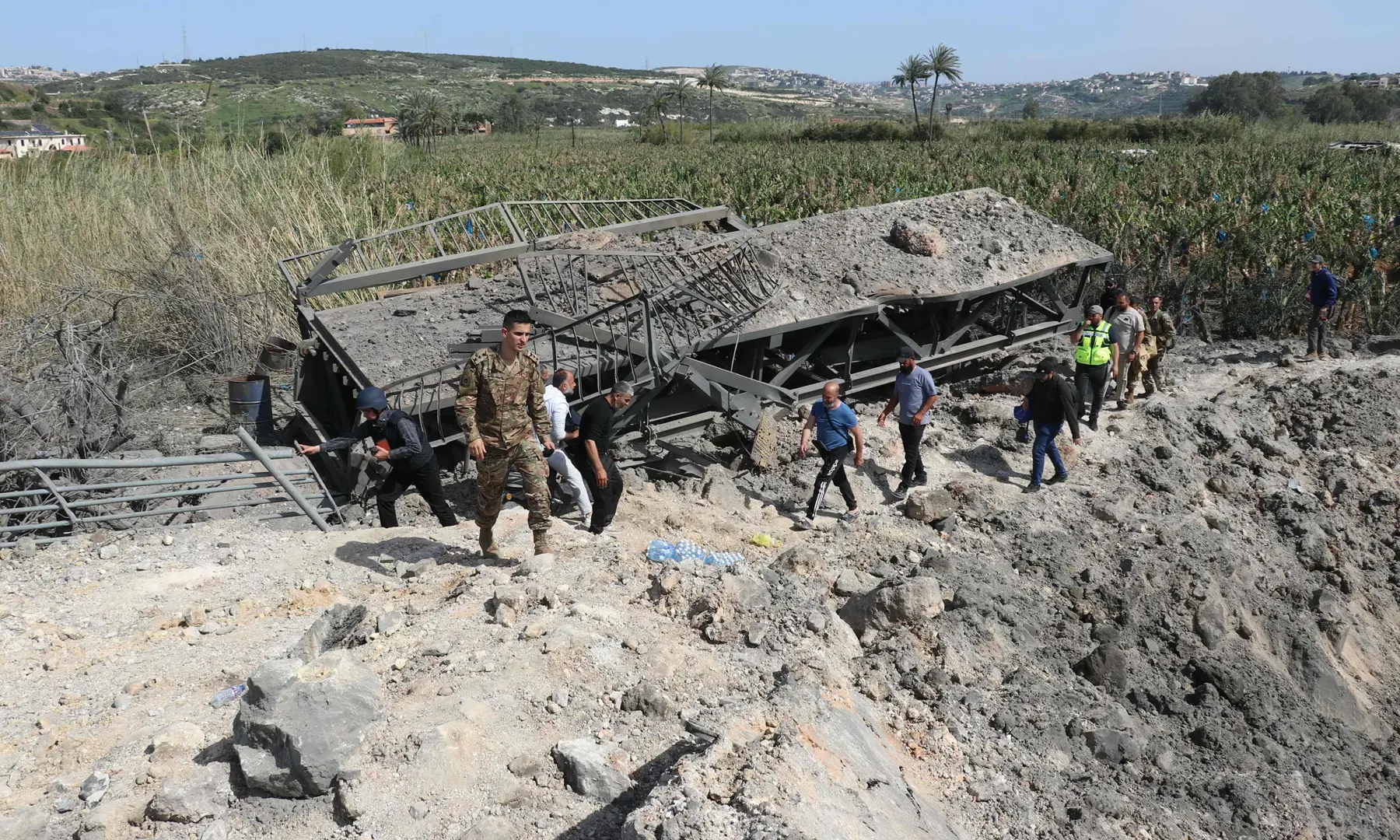
Meanwhile, Israeli attacks continued in south Lebanon, notably in the Lebanese border town of Bint Jbeil, a Hezbollah stronghold and strategic prize. A senior Lebanese official said Lebanon believed Israel wanted to secure a victory in Bint Jbeil before diplomatic progress could be made.
An Israeli strike destroyed the last bridge over the Litani River into the south, a senior Lebanese security source said, fully severing almost a tenth of Lebanon from the rest of the country after Israel destroyed other crossings during the war.