Water worries grip KP farmers amid Indus Treaty concerns

• Experts warn reduced river flows could worsen food insecurity and hunger
• Tarbela and Mangla dams rely on consistent water flow for irrigation and electricity
PESHAWAR: At sunrise in a quiet village of Dera Ismail Khan, 49-year-old farmer Adnan Khan kicks his motorbike to life and heads toward his wheat fields, worried about possible violations of the Indus Waters Treaty (IWT) by India.
The earth is still damp from recent rainfall, usually a welcome sign before harvest. Today, however, his routine inspection carries a different weight.
Slinging a sickle over his shoulder in Paharpur, he scans the soil not just for moisture, but for reassurance.
Like hundreds of thousands of farmers across Khyber Pakhtunkhwa, Adnan’s livelihood largely depends on the steady flow of water from the Indus River system.
Lately, that flow feels uncertain due to concerns over IWT violations.
“We live by this water,” he says quietly. “If it stops, everything stops.”
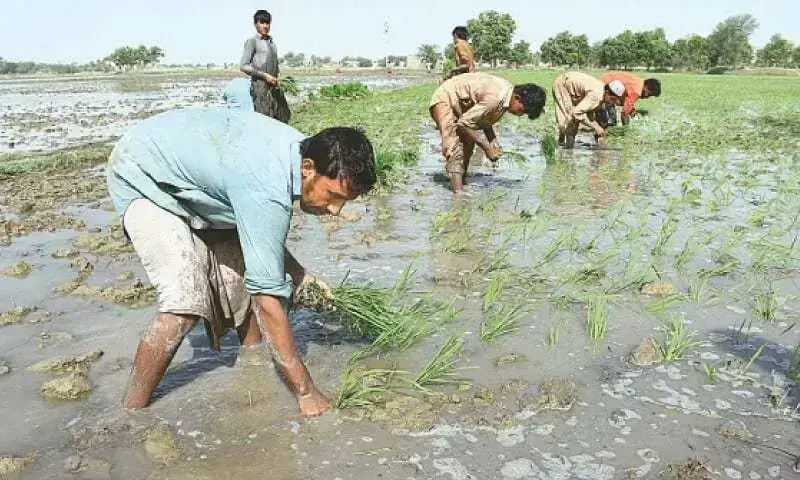
For generations, farmers in Dera Ismail Khan have relied on the Indus River to irrigate their wheat, maize, rice, and other crops, as well as orchards and vegetables.
Under the historic Indus Waters Treaty, Pakistan was granted rights over the western rivers, namely the Indus, Jhelum, and Chenab. The agreement, brokered by the World Bank in 1960, has long been considered a rare example of cooperation between Pakistan and India after it was signed by President Ayub Khan and Indian Prime Minister Jawaharlal Nehru.
However, for Adnan and many like him, that trust is eroding following fascist Modi government’s decision to hold the treaty in abeyance in April last year, showing disregard for international treaties and guarantees of the World Bank.
“If water in the river drops, our wheat drops,” he explains. “And when wheat drops, hunger rises, leading to malnourished children and struggling mothers.”
Farmers’ concerns are genuine and require immediate attention, particularly from the World Bank.
According to agricultural experts, Khyber Pakhtunkhwa produces only about 1.2 to 1.5 million tons of wheat annually — far short of its consumption needs of nearly 5 million tons. This gap forces reliance on other provinces, especially Punjab, often called the country’s breadbasket.
Professor Dr. Naeemur Rehman Khattak of the University of Peshawar warns that water shortages could worsen this imbalance if IWT violations continued.
“A 70 per cent production gap already exists,” he says. “Any disruption in river flows could make it worse, leading to hunger and food insecurity in the country.”
He adds that climate change, limited access to quality seeds, and small landholdings already strain farmers, and water uncertainty adds another layer of vulnerability.
The issue extends far beyond wheat and seasonal crops. Reduced water flow also threatens livestock, orchards, fisheries, and even honey production.
Dr Ejaz Khan, an international relations expert, describes the situation starkly: “Water is not just a resource — it is survival. Any disruption affects billions of living beings.”
He notes that major infrastructure such as the Tarbela and Mangla dams depends on consistent river flows for irrigation and electricity. A decline could trigger energy shortages alongside food insecurity in Pakistan.
Legal experts argue that the treaty does not allow unilateral suspension and remains binding on both countries. The Permanent Court of Arbitration has reaffirmed its binding nature, emphasising that any changes require mutual agreement.
They have urged the World Bank to intervene and force the Modi regime to reverse its illegal decision.
Yet for farmers like Adnan, legal debates feel distant. What matters most is whether water reaches his land to sustain his family.
Standing at the edge of his field, he scoops a handful of soil and lets it fall through his fingers.
“This land feeds us,” he says. “But it needs water to live.”
The Indus Basin supports nearly 300 million people across the region. Any disruption risks not just crops, but livelihoods, stability, and peace.
As the wheat harvest season approaches in Dera Ismail Khan, Adnan continues his daily rounds — watching the skies, checking the soil, and hoping the rivers keep flowing for the upcoming rice crop.
For him, and millions like him, water is not politics — it is life.
Published in Dawn, April 20th, 2026