India raises retail fuel prices for first time since Mideast war began
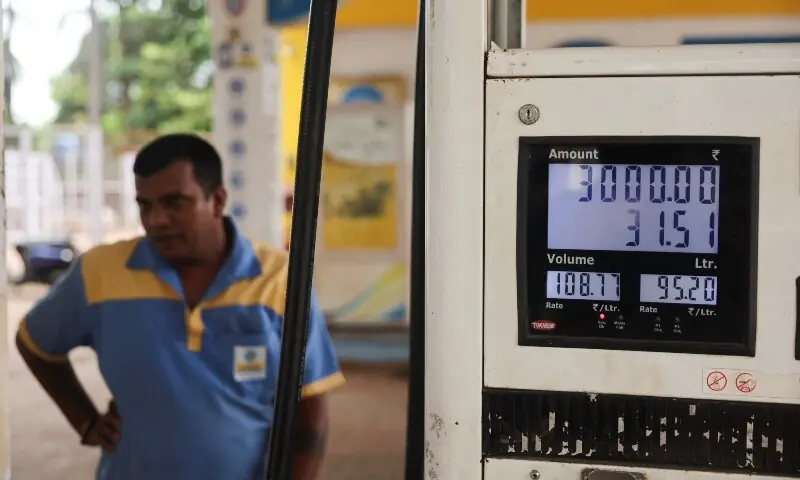

India’s state-run fuel retailers have raised petrol and diesel prices for the first time in four years by 3 Indian rupees ($0.03) per litre, or more than three per cent, according to dealers, to recoup some of the losses incurred due to higher global crude oil prices.
India — the world’s third-biggest oil importer and consumer — is one of the last major economies to raise retail fuel prices following the disruption to shipping through the Strait of Hormuz by the war started by US-Israeli attacks on Iran.
State-run Indian Oil Corp, Hindustan Petroleum Corp and Bharat Petroleum Corp, which together control more than 90pc of India’s 103,000 fuel stations, tend to set diesel and petrol prices in tandem.
A BPCL spokesperson confirmed the price increase at its retail outlets. Indian Oil and HPCL did not immediately respond to a request for comment.
Diesel in Delhi will cost 90.67 Indian rupees a litre and petrol 97.77 Indian rupees, reflecting increases of 3.4pc and 3.2pc, respectively, from 87.67 Indian rupees and 94.77 Indian rupees a litre.
Global oil prices spiked to more than $120 a barrel before pulling back to around $100 to $105.
Shares of fuel retailers were down between 2.4pc and 3.6pc on Friday. Indian Oil Corp fell 2.4pc, HPCL dropped 3.3pc, and BPCL was down 3.6pc as of 0550 GMT (10:50am PKT)
The direct impact of the higher fuel prices would be muted at about 15 basis points on consumer price inflation, although the indirect impact will be larger, said Madhavi Arora, chief economist at Mumbai-based Emkay Global Financial Services.
“The hikes are not enough but could be the start of multiple staggered hikes,” she said.
Fuel austerity steps
To curb fuel consumption and rein in oil import bills, New Delhi has rolled out austerity measures as policymakers brace for a prolonged energy shock.
On Sunday, Prime Minister Narendra Modi urged a spate of measures, including fuel conservation, work-from-home practices, and limits on travel and imports, as surging global energy prices put pressure on the country’s foreign exchange reserves.
Some states have issued notices to government departments this week to restrict travel, avoid physical events and shift meetings online, while also asking them to work from home two days a week, with offices half-staffed.
India is likely to widen the measures to cover millions of employees across the federal government, state-run banks and public sector firms, signalling a system-wide tightening of expenditure and operations as financial risks mount.
The government did not respond to a Reuters email seeking comment.
Price increase to hit demand
Analysts say the increase is modest and leaves plenty of scope to raise prices further to compensate for revenue losses.
“India’s petrol demand growth will be impacted, although the price hike is modest, but other fuel conservation steps, such as work from home, will dent demand growth,” said Prashant Vashisth, vice president and co-head of corporate ratings at Moody’s Indian arm, ICRA Ltd.
ICRA has revised its growth rate for gasoline use to 3pc-4pc this year, compared with 5pc-6pc before the war, due to the price increase. For gasoil or diesel, ICRA expects growth to be flat from an earlier estimate of 2pc-3pc.
Analysts and opposition parties said state retailers had delayed raising prices during key state elections. The polls ended this month, with Modi’s BJP winning two of four states and expanding its influence.
Oil ministry official Sujata Sharma said in April that higher oil prices after the war started caused Indian retailers to lose about 100 Indian rupees per litre on diesel and about 20 Indian rupees a litre on petrol.
In late March, Russia-backed Indian private refiner Nayara Energy raised its pump prices to mitigate some of its revenue losses from retail sales.