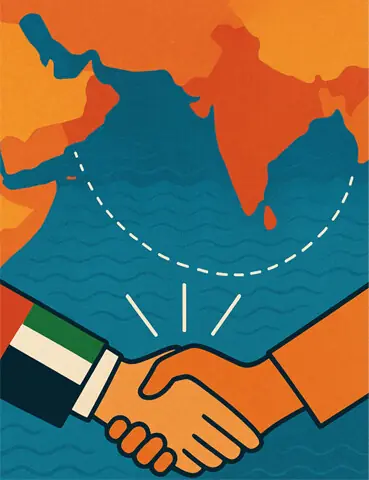
RECENT media reports suggest there is a strategic cooperation between India and the United Arab Emirates (UAE), which points to a broader transformation underway in the Gulf and Indian Ocean security. What is taking shape is not a traditional alliance, but a flexible network of partner-ships driven by economic interdependence, maritime security concerns, and a pre-ference for strategic flexibility.
The UAE’s growing engagement with India stems from a foreign policy doctrine adopted after 2015, built around diversi-fication. The UAE has sought to deepen ties with several major players simultan-eously, including the United States, Israel, India and key Asian economies, while reducing dependence on any single security partner. This shift has been accelerated by persistent regional in-stability, including tensions with Iran and the changing dynamics of Arab regional politics. These have reinforced the UAE’s preference for a distributed security approach over traditional alignment.
For India, the Gulf is no longer its primary source of energy. It is now treated as an extension of India’s own maritime security zone. New Delhi’s aims in building closer defence ties with the UAE reflect securing shipping routes through the Strait of Hormuz, improving awareness of mari-time activity across the Arabian Sea, expanding defence industry collaboration, and establishing India as a leading security partner in the Gulf and Arabian Sea. These goals are also directly connected to India’s wider effort to respond to China’s growing naval presence across the Indian Ocean.
The India-UAE defence relationship is best understood as cooperation built in layers, rather than a formal alliance. It covers maritime coordination, defence technology, intelligence sharing and joint military exercises designed to improve operational compatibility. Importantly, this security dimension sits within a broader economic relationship involving trade, logistics and direct investment, giving the partnership both substance and staying power.
For Pakistan, this developing alignment presents challenges that are slow-moving, but deep-rooted. Most immediately, competition for influence in Gulf capitals is intensifying, as India’s economic weight increasingly translates into strategic access. At the same time, Pakistan’s ability to draw on Gulf diplomatic support over sensitive political matters is narrowing, as Gulf states increasingly keep bilateral relations separate from disputes involving third parties.
Sovereign investment from Gulf partners is also being directed more and more towards India’s larger and more varied economy, gradually eroding Pakistan’s relative position. Pakistan’s relations with the UAE remain significant, but are increasingly shaped by practical rather than strategic considerations. Labour migration, remittances and periodic financial assistance continue to form the foundation of the relationship even as the level of strategic alignment has declined compared to earlier decades.
Therefore, the challenge Pakistan faces is structural, not episodic, and cannot be resolved through diplomacy alone. It requires economic stabilisation, a broadening of Gulf partnerships beyond the UAE, and fresh investment in maritime security and logistics capacity in the Arabian Sea. Equally pressing is the need to establish Pakistan as a credible connectivity hub linking China, Central Asia and Gulf economies.
As such, the wider picture is becoming increasingly apparent that economic scale, technological capacity, and maritime connectivity are now the primary measures of regional influence. Pakistan’s task is now to engage with this changing land-scape on its own terms, rather than through frameworks that no longer reflect how the region actually works.
Lt-Col (retd) Syed Raziuddin
Rawalpindi
Published in Dawn, May 21st, 2026